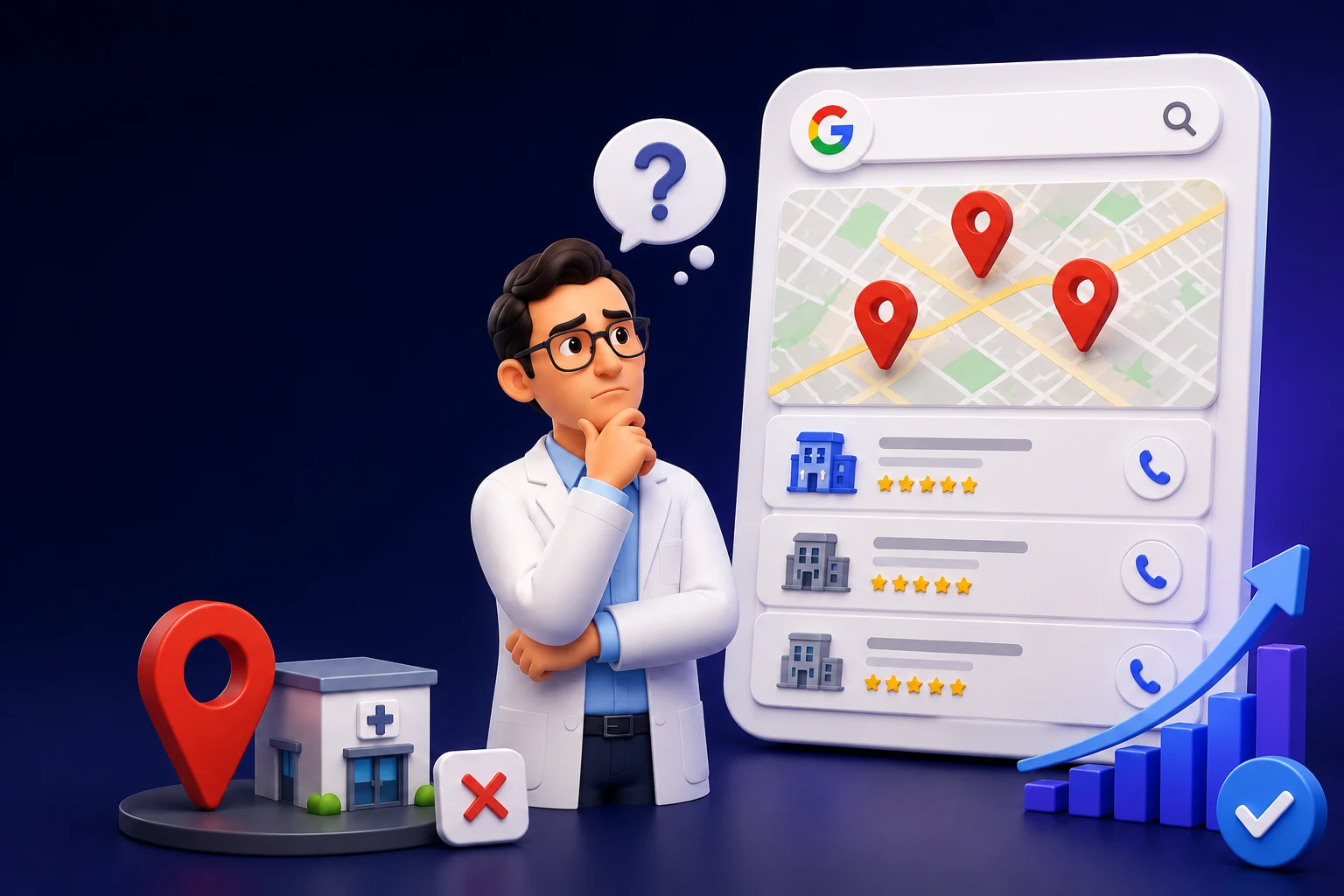
When someone nearby searches for a doctor or a lawyer, Google shows a small box of three listings with a map above the usual blue links. That box is the local map pack, and it collects most of the clicks on local searches. If your practice isn't one of the three, most people scrolling on their phone never see you.
The frustrating part is that being good at what you do isn't enough on its own. The pack runs on signals Google can read, and plenty of excellent practices sit just below it because those signals are incomplete. Here's what actually decides the order, and the changes that tend to move a practice up.
What the map pack really is
The pack is pulled from Google Business Profiles, not directly from your website. It shows up for searches with local intent, the near-me queries and the ones where Google can tell you want somewhere close. Because it sits above the regular results and shows reviews and a tap-to-call button, it's often the only thing a searcher looks at before they pick up the phone. On a phone, where most of these searches happen, the pack can fill the whole first screen.
There are only three spots. That is the whole game. Everything below is about being one of the three, and everything Google reads about you feeds that decision.
The three things Google weighs
Google has said it ranks local results on a mix of three factors. Knowing them tells you where your effort actually goes.
Relevance
How well your profile matches what the person searched. Your primary category, the services you list, and the words on your profile and site all feed this. A profile set to the wrong category, or missing half the services you offer, quietly loses searches you should win. The primary category is the single biggest on-profile lever, so it is worth getting exactly right rather than close enough.
Distance
How close you are to the searcher. You can't move your office, but you can make sure your address, service areas and location signals are correct so Google places you where you actually are. If Google is unsure where you operate, it hedges, and hedging costs you the searches at the edge of your area.
Prominence
How well known and trusted you look. This comes from reviews, mentions on other sites, and the strength of your own website. It's also the factor you have the most room to improve, which is why most of the work below points at it.
The levers you can actually pull
Complete and correct your Google Business Profile
Set the right primary category, add every service you offer, write a real description, and keep your hours current, including holidays. Add genuine photos of your office, your team and the entrance, and keep the profile active rather than set-and-forget. A thin or half-finished profile is the most common reason a practice ranks below one that's otherwise no better. The field-by-field version of this is in the walkthrough for doctors and dentists and the one for law firms.
Earn reviews, and reply to them
A steady flow of recent reviews does more for prominence than a pile of old ones. Recency and consistency matter, so a practice that gets a few reviews every week tends to outrank one that got thirty in a single month two years ago. Ask every patient or client, make it easy with a direct link, and reply to what comes in, including the occasional bad one. A calm, professional reply to a complaint reassures the next person reading it far more than a wall of five stars with no responses. Don't buy reviews or gate them so only happy clients can leave one, because Google is good at spotting both and the penalty is not worth it. Those same reviews feed how AI engines recommend you too, so the effort pays off twice.
It's worth being precise about what part of that actually moves rankings, because the answer changes what you chase. Reviews feed prominence, and prominence is only one of the three factors. No volume of them shortens the distance between you and the searcher, and none of them makes you relevant to a service your categories say you don't offer. What they do is settle the order among the practices already eligible, which is usually where the contest is. Within that, the count, the recency and the rate they arrive at all carry weight, and the text carries more than it used to now that answers get assembled out of it. Your star average matters far more to the person reading than to the ranking itself, and replying doesn't move the ranking directly at all, though it changes who calls.
Getting them is a different job in a clinic than it is in a firm, so there's a walkthrough for each: asking patients without breaking the rules, and asking clients when half the book can't be asked. If a review has already landed badly, what a medical practice may safely say in reply is narrower than most practices assume.
Keep your details identical everywhere
Your name, address and phone should read the same on your site, your profile and every directory you appear in. Those listings are called citations, and when the details conflict across the web, it makes Google less confident about you. Confidence is exactly what prominence rewards, so clean up the old listings with a former address or a tracking number, and fix the duplicates before you chase anything fancier.
Give each location and service its own page
A page on your site that genuinely covers a service in your city, with real information rather than a thin stub, backs up the relevance of your profile, whether you run a dental practice or a law firm. If you serve more than one area, each deserves its own real page instead of a single list of city names. The goal is a page a human would find useful, not a doorway built only for Google, because the thin version tends to do nothing or backfire.
Want to know exactly why your profile is stuck below the pack?
Get your free auditHow long this takes
Local ranking moves in weeks and months, not days. Reviews accumulate, citations get cleaned up, and Google gradually gets more confident about you. There is rarely one dramatic jump. It is usually a slow climb as the signals stack up, then a point where you are suddenly in the pack for the searches that matter.
Anyone promising you the top spot by next week is selling something. The practices that win the pack are usually the ones that stayed consistent while their competitors didn't. If you're not sure why you're stuck just below it, that's exactly what a free audit is for. I look at your profile, your reviews and your site together, and tell you the two or three things holding you back.
If you used to be in the box and aren't any more, that's a different question with its own short list of causes, worked through in why a practice drops out of the map pack.

Founder of Proximity Ranker, with nine years in SEO and a law background that shapes the medical and legal work we do. Meet the founder.