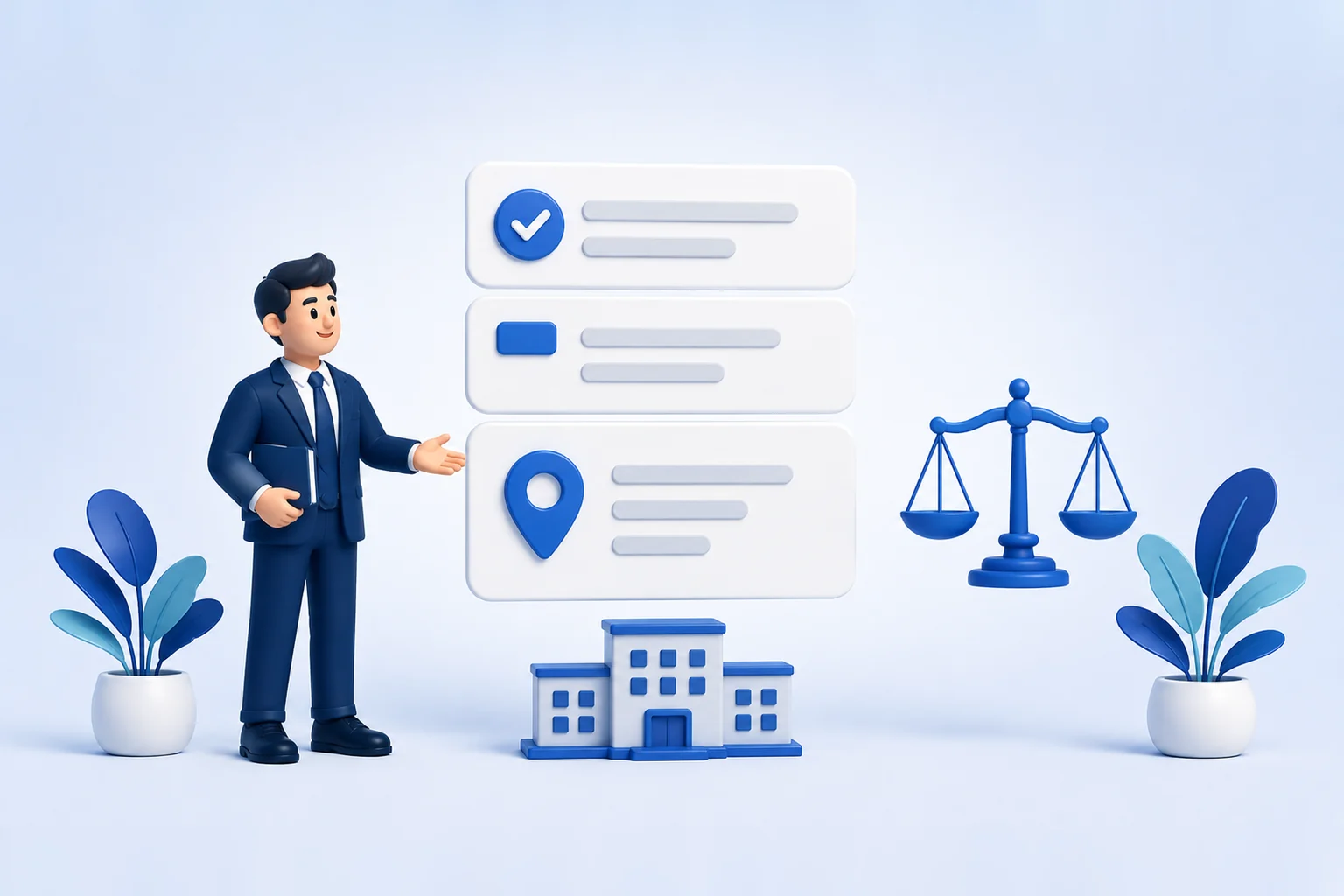
Search for a lawyer and look at what sits above the fold. Local Services Ads with a blue check beside each firm, then the paid search ads, then the map pack and its three listings. For most businesses the top of a local result is busy. For legal it's the most contested space in local search, and three separate products are competing for one click.
One of those three boxes is free. Your Google Business Profile is the entire input to it, which makes it the most valuable unpaid asset a firm owns, and the one most often left exactly as somebody set it up years ago.
The address rule, which suspends more firm listings than anything else
Google's guidelines are stricter here than most firms realize, and legal is a field where the temptation to bend them runs high because so much of the work happens remotely.
A location qualifies if clients can be received there during the hours you publish. A rented mailing address doesn't qualify. A co-working space qualifies only where your office there carries clear signage, receives clients, and is staffed during business hours by your own people. A conference room booked by the hour when something needs signing is not an office in Google's terms.
The consequence is suspension. Recovering a suspended listing is slow and uncertain, and every week of it is spent outside the free box. A firm genuinely running several staffed offices gets a profile for each. A firm working from one office and covering a wider area gets one profile, and the coverage argument gets made on the website instead.
One primary category, five practice areas
A firm doing injury, criminal, family and immigration work still gets one primary category. That constraint is what makes this decision harder for a law firm than for almost any other local business, where the primary category is self-evident.
Pick it for the cases you want more of rather than the ones currently paying the bills, because the primary is what you're most eligible to surface for. Secondary categories carry the other areas without competing with it. Anything that fits in neither belongs on your site as its own page, which is the ordinary way SEO for an injury firm or for a divorce practice covers ground the profile can't reach.
Not sure which practice area your firm should be leading with?
Get your free auditAttorney listings, and when they're worth having
Google lets a public-facing professional with their own clients hold a listing separate from the organization's. For a firm that means a named partner can have a profile alongside the firm's.
It's worth doing where clients search for the person: referral-driven work, and any firm whose name is somebody's name. It isn't worth doing for every associate, and one attorney holds one listing rather than one per practice area they handle. A neglected attorney profile works against you, because it's what a prospective client finds when they search the name they were given over the phone.
The blue check is a different product
This is the most common misunderstanding I run into with firms. It costs people weeks of the wrong work.
The blue Google Verified badge belongs to Local Services Ads, a pay-per-lead product sitting above the ordinary search ads. Google consolidated its older badges, Google Screened, Google Guaranteed and License Verified, into that single Google Verified check in late 2025. It requires license and identity verification, and it appears on your Local Services Ads profile.
It does not appear on your Business Profile, and no amount of profile optimization earns it. Wanting the badge means buying into a separate channel with its own budget and its own economics, which is a different line in the marketing budget from your organic work. Worth it for some practice areas and not others. The thing to avoid is mistaking it for the free box.
Reviews when clients can't say why they hired you
Every local ranking guide tells you to ask for reviews. In criminal, family or immigration work that advice runs straight into the fact that most clients will not attach their name to what they hired you for.
What works is narrowing who you ask and being careful about what you say back.
- Ask the clients who can. Business, estate and civil matters carry far less stigma than the areas people keep private.
- Never offer anything in return and never ask only the happy ones. Screening who gets asked is against Google's policy, and the Federal Trade Commission has its own rule covering incentives.
- Reply to everything including the bad ones, without confirming the person was a client or referring to any detail of a matter. Your duty of confidentiality doesn't pause because the complaint is public.
- Check your own state's bar advertising rules before you solicit at scale or lift a review into a testimonial on your site. They vary by state, some require specific disclaimers, and this is one of the few marketing questions where the answer genuinely turns on where you're admitted.
Fifteen substantial reviews describing the process, the communication and the outcome in general terms put a firm in better shape than sixty one-line ratings, and that's a realistic target for a practice where discretion is the whole point.
If you only have an hour
In this order, because the first two are worth more than the rest together.
- Confirm the address on the listing is an office you actually staff during the hours you publish.
- Set the primary category to the cases you want more of.
- Fill the services list with your practice areas in the words a client would use, not the words in the statute.
- Add photographs of the building, the entrance and the people. Firms are unusually bad at this and it's the cheapest credibility on the page.
- Reply to every review sitting unanswered.
Start with the listings you forgot you had
Almost every firm I look at has more listings than it thinks. A profile at the address from two moves ago. One under the old name from before the partnership changed. A solo listing a partner created years back and can no longer log into. Duplicates a directory generated automatically and nobody ever saw.
They matter because they split signals that should all point at one place, and because a client can find and call a number that stopped working in 2019. Clearing them costs nothing except the finding, and the finding is the part that takes somebody who knows where to look.
That's the first thing the free audit does for a firm. I search the ways your name, your partners' names and your addresses appear across Google and the directories, list what exists and what state each one is in, and mark which to claim, which to merge and which to have removed. It comes back within 24 to 48 hours at no cost, and it's the cleanup list worth working through before you spend money on anything else.
Want the list of every profile out there carrying your firm's name?
Get your free audit
Founder of Proximity Ranker, with nine years in SEO and a law background that shapes the medical and legal work we do. Meet the founder.