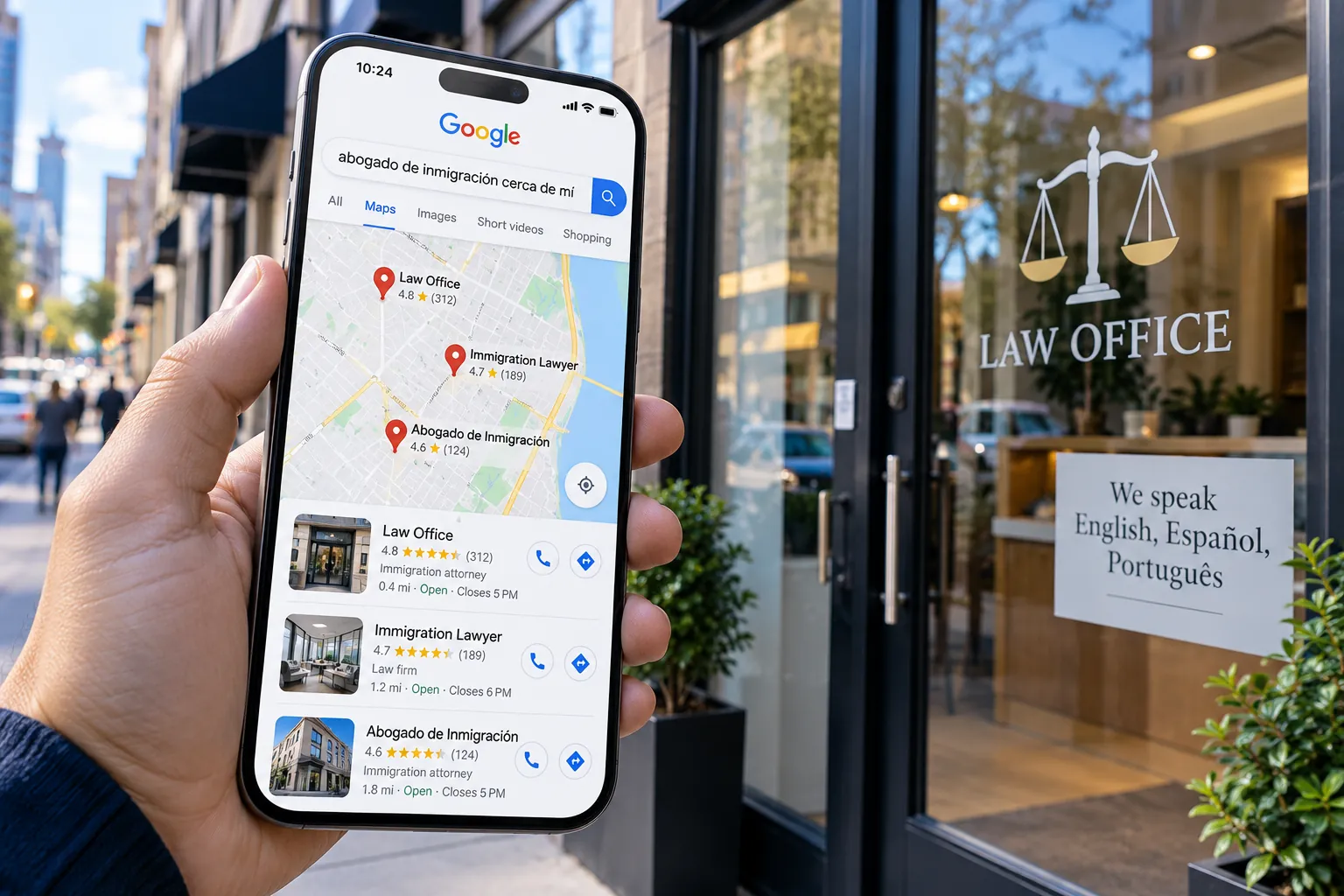

Short answer: a law firm gets more Google reviews by asking every satisfied client at the moment their matter turns out well, in person first and then with Google's own review link, in the client's language, and by making it a routine instead of a favor. Never offer anything in return and never ask only the clients you expect to be happy, because Google treats both as fake engagement. Reply to every review without saying anything about the person's matter.
I'm Ashikur Rahman, founder of Proximity Ranker. I'm an SEO and AI search specialist with legal training (an LL.B and an LL.M), and reviews are part of the work I do on law firms' Business Profiles. For one Queens injury firm, the profile brought in 70 calls in June 2026, 25% more than a year earlier, and for another client Google removed every review in the removal request I filed. Both dashboards are on my case studies page. This guide is about the search and reputation side; your own lawyers and bar or law society decide the professional conduct side.
Why do Google reviews matter so much for a law firm?
They count three times. People read them before they call: Martindale-Avvo's 2026 research on legal consumers found that 92.4% of people research before contacting a lawyer and that reviews were the factor most of them found helpful when choosing one. BrightLocal's 2026 consumer survey found 97% of people read reviews when choosing a local business and 41% always do, up from 29% a year earlier.
Google uses them too. Reviews are part of prominence, one of the three factors Google says decide local rankings, so a steady flow of new reviews helps the firm hold its place in the map pack. And AI engines read them. When ChatGPT or Google's AI describes a firm, it often borrows the language of its reviews, so what clients write becomes part of how the engines talk about you.
When is the best time to ask a legal client for a review?
At the moment of relief, before the file closes and life moves on. Every practice has these moments:
- Personal injury: when the settlement is agreed, when the check arrives, or when treatment ends and the case wraps up.
- Criminal defense: when a charge is dropped or reduced, or when a long matter finally ends.
- Family law: when the final order is signed or an arrangement the client was worried about is settled.
- Immigration: when the approval the client has been waiting for arrives.
- Estate planning and business work: when the documents are signed and the client tells you how relieved they are to have it done.
Ask in person or on the call where you share the news, then send the link the same day. A request three months later, after the bill, gets a fraction of the response.
How do you make leaving a review easy?
- Use Google's own review link. In your Business Profile, open Read reviews, then Get more reviews, and copy the link. It opens the review form directly, with no searching.
- Print the QR code. The same screen gives a QR code (generated from a computer browser, not a phone), which works well on a card handed over at the final meeting.
- Send it by text and email, short and personal: thank the client, say a review helps other people find the firm, and paste the link.
- Write in the client's language. A request in Spanish to a client who worked with you in Spanish gets a very different response from an English template.
- Follow up once, a few days later, and then leave it.
- Tell clients that a first name or initials is fine and that they shouldn't include details about their case.
What do Google's review rules forbid?
- Rewards of any kind: discounts, gift cards, prize draws or a reduced fee. Google calls incentives for reviews fake engagement and prohibits them.
- Review gating: asking how the experience was and sending only the happy clients to Google. Google forbids selectively asking for positive reviews.
- Reviews written by staff, family or friends, or by the firm on a client's behalf, and buying reviews in any form.
- Asking a client to remove or change a negative review in exchange for anything.
- Reviewing a competitor, or having someone do it for you.
Breaking these can get reviews removed in bulk, the profile restricted or a warning shown to people who view it. Your bar or law society's rules on giving anything of value for a recommendation may apply as well, which is one more reason never to reward a review.
What if a client doesn't want to post a public review?
Respect it completely. A criminal defense client may not want anyone to know they were charged, a family law client may not want a former partner reading about the case, and many clients in sensitive matters prefer to leave no public trace. Make the request clearly optional and never ask twice after a no. The clients who are comfortable will leave plenty of reviews if you ask every time.
Want a review request routine set up for your firm?
Get the auditHow should a law firm respond to Google reviews?
Lawyers have to be more careful here than almost any other business, because a reply is public and permanent. The safest approach for every reply is the same: don't confirm that the person was a client and don't mention anything about a matter, even if the reviewer described it themselves. Check your bar or law society's guidance on responding to online reviews, since several have published it.
- Positive reviews: a short, warm thank-you is enough. Don't add details about the case.
- Negative reviews: a brief, calm reply that says the firm takes feedback seriously and invites the person to contact the office directly. Sometimes no reply is the better choice.
- Never argue the facts in public, however unfair the review feels. In criminal and family matters the reviewer is sometimes the other side, and an argument only draws more attention to the review.
- Reply in the language the review was written in.
Can a law firm get unfair Google reviews removed?
Sometimes, if the review breaks Google's content policy. Common examples are reviews from someone the firm never represented, reviews from an opposing party, reviews that contain harassment or hate, reviews that are off-topic, reviews posted by a competitor or from a conflict of interest, and the same review copied across several firms' profiles. A review that is simply negative and honest won't be removed, and nobody can promise a removal, because Google decides.
The process is to report the review from the profile, then use Google's review management tool to follow up with evidence of the specific policy each one breaks. For one client, Google confirmed on 27 September 2026 that the reported reviews violated its policies and made every removal requested. That's the negative review removal service, and it's charged only for reviews Google actually takes down.
Why do the words in a review matter?
A review that says the lawyer explained every step before the hearing and returned calls the same day tells the next reader what kind of help to expect. It also gives Google and the AI engines something specific. When ChatGPT describes your firm, it draws on that kind of language. You can't tell clients what to write, but you can ask them to describe the experience in their own words rather than just leaving stars. More on how AI engines use reviews in how to get your law firm in ChatGPT search results.
What does review management cost for a law firm?
On my $799 a month SEO plan, review work is included: the request routine, monitoring, replies drafted for your approval and removal requests for reviews that break Google's rules. The plan also covers the Business Profile, local and on-page SEO, AI search and a monthly report, with the audit and Google Ads management included and a free website after a six-month commitment.
Without the plan, negative review removal costs $199 for each review Google removes and nothing for the ones it doesn't. The audit is $350 for one office or $550 for two, Ads management $499 a month and a website from $799. The pricing page lists everything, and my Google Business Profile guide for lawyers covers the rest of the profile.
What else do law firm owners ask?
01How many Google reviews does a law firm need?
There's no fixed number. Look at the three firms in the map pack for your main search and aim to match or pass their count, then keep reviews coming every month. A steady flow of recent reviews counts for more than a large pile from years ago, both with Google and with people reading them.
02Can a law firm ask clients for reviews by text message?
Yes. Google's own review link works in a text, an email or a message app. Keep it short, personal and sent soon after the good news, and only to clients who have agreed to hear from the firm that way.
03Should a law firm use review software?
It can help a busy firm send requests on schedule. Avoid any tool that asks clients to rate the firm first and only sends happy clients to Google, because that's review gating, which Google forbids. A tool should send the same request to everyone.
04Do reviews on Avvo, Yelp and Facebook matter too?
Yes, to a lesser degree. Google's reviews matter most for the map pack, but people check several sites. BrightLocal's 2026 survey found consumers use about six review sites on average, and AI engines read reviews from several sources when they describe a firm.
05What should a firm do about a fake review from someone it never represented?
Report it from the Business Profile as not genuine, then follow up through Google's review management tool, explaining which policy it breaks. Keep your public reply short and neutral, and don't reveal whether the person was or wasn't a client. If the first request is refused, a well-documented appeal often succeeds.