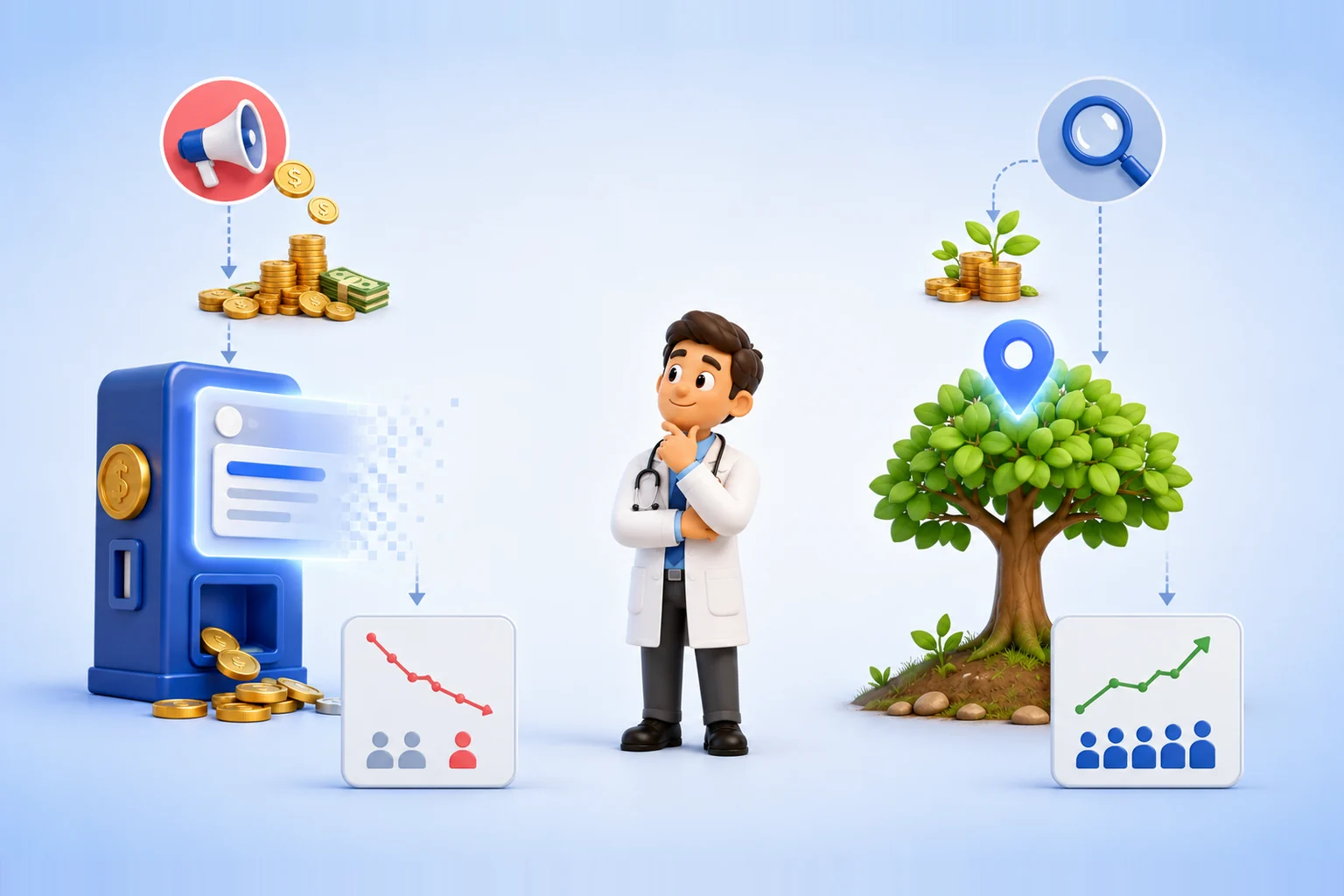
Google Ads buys you the top of the page today and charges you for every click, and it stops the moment you stop paying. SEO earns your place over weeks and months, costs nothing per click once you rank, and keeps working after you stop. Ads are rented visibility. SEO is an asset you own. For most medical practices the right answer is both, weighted toward SEO over time.
The honest question is not which one is better. It's which does what, and when each is worth the money. Here is the comparison without the sales pitch.
Google Ads: instant, targeted, and rented
With Google Ads you pay to sit at the very top of the results, above the map pack and the organic listings, for the searches you choose. You can be live this afternoon, show only in your area, and switch it on and off at will. That speed is the whole appeal, and for the right situation it is worth a lot.
The catch is that you pay for every click, whether or not it becomes a patient, and medical keywords are among the most expensive clicks in all of Google Ads. A single click on a competitive treatment term can cost more than a nice lunch. And the day your budget runs out, your visibility disappears with it. You are renting the spot, not keeping it.
SEO: slower to build, yours to keep
SEO is the work of earning your rankings and your place in the map pack, so patients find you without you paying for the click. It takes longer to show up, usually weeks for local terms and months for competitive ones, because you are building something Google has to trust rather than buying a slot outright.
But once it is working, the economics flip. The clicks are free, the results compound instead of resetting each month, and the pages keep bringing in patients while you sleep. Stop paying an agency and your rankings do not vanish overnight the way ads do. You built an asset, and it stays on your side of the ledger.
Where each one actually wins
Ads win when you need patients now
A brand-new practice with no rankings yet, a new service you are launching, a slow season you want to fill, or a competitor you need to answer this month. Ads are the fastest way to turn on demand, and they are excellent for testing which treatments and messages actually convert before you commit SEO effort to them.
SEO wins when you want a lower cost per patient over time
The steady core of your schedule: the near-me searches, the map pack, the treatment pages patients research for weeks. This is where most of your bookings come from long-term, and where paying per click forever makes no sense. The same holds whether you are a dentist, a gastroenterologist, or an ophthalmologist: the searches that fill your schedule for the long term are the organic ones, not the paid ones. Every month SEO runs, your cost to bring in a patient tends to fall, while ads hold roughly flat or climb as competitors bid the price up.
The trust patients bring to a health decision
Choosing a doctor is not the same as buying a gadget. Plenty of patients, especially for anything serious, scroll straight past the results marked Sponsored and look at the map pack and the organic listings, because a practice that earned its spot reads as more credible than one that paid for it. Ads still catch the urgent, high-intent searches, the emergency and the same-day, but for the researched decision, being the organic answer carries a weight an ad does not.
The one thing ads can never buy
You cannot pay your way into an AI answer. When a patient asks ChatGPT, Google's AI Overviews or Perplexity which specialist to see, those engines draw on the open web and the practices that have earned authority there. There is no ad slot. As more patients start their search by asking an assistant, the practices that invested in SEO get named, and the ones renting ads are invisible in that conversation. That gap only widens from here.
Not sure whether your budget belongs in ads, SEO, or both?
Get your free auditSo which should you choose?
For most practices it is not one or the other, and the smartest play uses both in sequence. Run ads to bring in patients immediately, while SEO builds underneath. As your rankings and map pack presence mature, you lean more on SEO and taper the ad spend, because you no longer need to rent what you now own.
If your budget genuinely forces one, it comes down to where you are. An established practice with some visibility is usually better off putting the money into SEO and keeping every future click free. A brand-new practice with nothing yet may need a little ad spend to prime the pump while SEO catches up. Neither answer fits everyone, which is exactly why a blanket recommendation from someone who has not looked at your practice is worth ignoring.
The honest way to decide
The right split depends on things a blog post cannot see: where you rank now, how visible you already are, what your competitors are doing, and how fast you need the phone to ring. So I start by looking.
A free audit shows you where you stand and where each dollar works hardest for your practice, and you get a straight recommendation rather than a pitch for whatever I would rather sell you. It comes back within 24 to 48 hours, at no cost, with no lock-in. If it is SEO you want costed out first, see what SEO costs for a medical practice. That is the honest way to answer SEO or ads: with your actual numbers in front of you.
Ready to see where your budget works hardest?
Get your free audit
Founder of Proximity Ranker, with nine years in SEO and a law background that shapes the medical and legal work we do. Meet the founder.