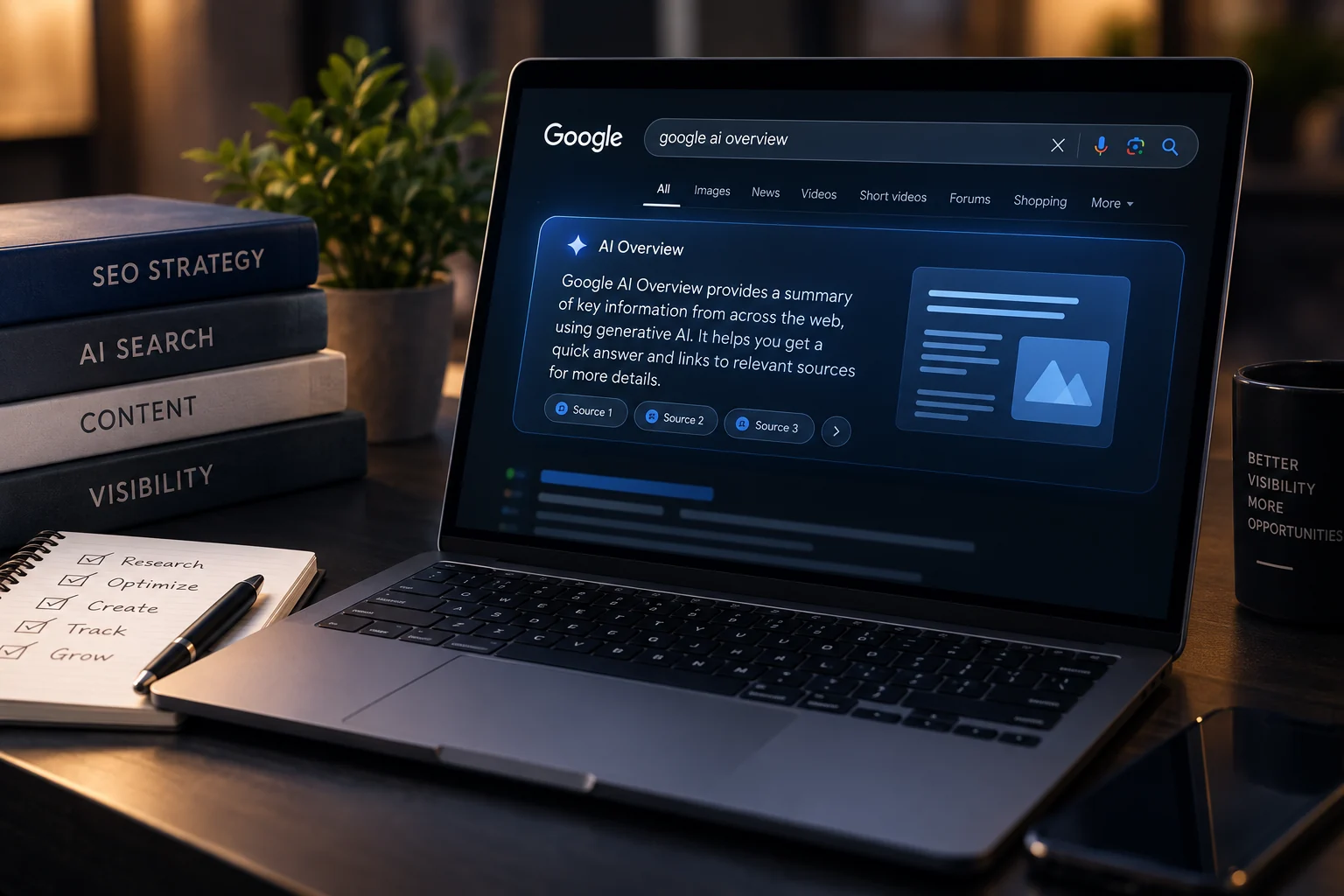
There's a lot of confident writing about AI Overviews, and most of it was written by someone who has never run the experiment. The useful thing is that Google has published how the feature assembles an answer, in its own developer documentation, in fairly plain language. Read that first and the work stops being mystical.
What follows is the chain in the order it happens, because the order matters. Each link depends on the one before it, and there's no point in polishing link three while link one is broken. In practice, when I look at a medical or legal site that never appears in these answers, the break is almost always in the first link, and almost never in the one the owner was worried about.
It isn't a new index, it's a summary over the old one
Google describes the technique as retrieval augmented generation, or grounding. Its core Search ranking systems retrieve relevant pages from the Search index, and the model then writes a response over the specific information in those retrieved pages, showing clickable links to the pages that support it.
That sentence has a consequence people skip past. There's no separate AI index to submit to, no AI sitemap, no schema type that opts you in. The pool of candidate sources is the Search index. If a page isn't in there, it can't be summarized, no matter how well written it's.
Google states the eligibility bar directly: to be shown as a supporting link, a page has to be indexed and eligible to appear in Search with a snippet, meeting the ordinary technical requirements. It says there are no additional technical requirements beyond that. Which is either a relief or an anticlimax, depending on what you were sold.
Link one: can the page be retrieved at all
This is where practice sites fail, and it's rarely dramatic. A few of the ways I have seen it happen on real sites:
- The condition pages exist but were never indexed, usually because nothing internal links to them and they aren't in the sitemap. They're reachable from the menu on a desktop and from nowhere on a phone.
- A nosnippet tag is sitting in the template. It stops Google displaying a snippet for the page, and Google lists it among the controls that set your display preferences in AI experiences too. Somebody added it years ago to stop a competitor scraping copy.
- A data-nosnippet attribute wraps the part of the page that actually answers the question, often the FAQ block, because it was added to keep a disclaimer out of search results and the wrapper is bigger than anyone intended.
- The whole answer is rendered by a script that Googlebot is blocked from loading, so the page indexes as a shell with a heading and no body.
- The page is indexed, but the text lives inside an image. A rendered PDF of a fee schedule can't be quoted.
None of those are strategy problems. They're half an hour of work, and they gate everything downstream. Before anyone spends a month rewriting content for AI, check that the pages you want cited are indexed, snippet-eligible and rendering their own text. That check is the first thing in a proper audit for exactly this reason.
One clarification worth having, because it costs people traffic. Google-Extended is a separate robots.txt control, and it governs training and grounding in other Google systems rather than what shows in Search. The snippet controls are what govern Search, including its AI features. Blocking the wrong one out of caution is a decision worth making deliberately rather than by accident.
Not sure whether your condition pages are even eligible to be cited?
Get your free auditLink two: is there a sentence worth lifting
Once a page can be retrieved, the model needs something in it that answers the question cleanly. This is the part where writing style does real work, and it isn't the part most practices spend their money on.
A page that opens with two paragraphs of atmosphere before it says what the procedure is gives a model nothing to hold. A page that answers the question in the first sentence under a heading that matches the question gives it a clean piece. That isn't a trick for machines. It's the same structure that works on a worried person reading on a phone at eleven at night.
Specifics matter more than length here. Compare two versions of the same claim. We offer a range of advanced treatment options for sleep apnea. Against: we fit oral appliances for patients who could not tolerate CPAP, we order home sleep tests, and we refer for surgical evaluation when the anatomy calls for it. The second one can be quoted. The first one can't be quoted by anybody, including a human.
The other half of this is agreement between what the page says and what your structured data says. When the visible text and the markup describe the same practice, the same services and the same location, an engine can lift them with confidence. When they disagree, it hedges or picks somebody else. I have found sites where the schema still listed an address the practice left in 2021, and everything downstream was quietly poisoned by it.
Link three: does anything outside your site agree
The third link is the one nobody controls directly, and the one that decides most contested answers. When an engine is choosing which of four local practices to name, it's looking for corroboration. Directories, reviews, professional listings, local press, a hospital affiliation page, a society profile. The same facts, stated by somebody who is not you.
This is why the boring listing work keeps paying. If your name, address and phone number are written three different ways across the web, every source that mentions you is slightly contradicting the others, and a model reading all of them has no clean fact to state. That's the practical argument for keeping one canonical set of contact details, and it matters more now than it did when it was only about local ranking.
Reviews do double work here too. An assistant reading reviews is reading for the specifics people mention, not just the star average. A review that says the surgeon explained the risks twice and drew a diagram is a quotable fact about how you practice. A review that says great service isn't.
One question fires several searches
Google describes a query fan-out technique: the system issues multiple related searches across subtopics and data sources while building a response, which is how it ends up showing a wider set of links than a classic results page would.
For a practice this changes what you should be writing. Optimizing a page for one exact phrase is the wrong shape of effort, because the phrase typed isn't the set of searches that actually ran. Covering a subject properly, including the awkward adjacent questions nobody else answers, is what gets you pulled into answers you never targeted.
It also explains something that confuses owners. You can be cited for a question you never thought about, and absent from the one you built the page for. The fan-out ran, your page matched one of the branches, and that was enough. Chasing that with a keyword list will drive you slowly mad.
What doesn't work, based on the sites I have had to clean up
A short list, because there's money being spent on all four:
- Adding the letters AI to your headings. There's no mechanism by which this helps. It's the 2026 version of stuffing a keyword into a footer.
- Publishing forty thin pages so there's more surface area. Scaled content produced mainly to game rankings is named in Google's spam policies, and thin pages dilute the specific ones that were working.
- A separate answers page that duplicates the condition pages. You now have two pages competing to be the source, and the engine picks neither with confidence.
- Buying a tool that promises AI Overview placement. Nobody sells placement. The candidate pool is the Search index and the selection happens at query time.
One thing that does exist and is worth knowing about: Google has a preferred sources feature, where a person can tell Search which publications they want to see more of. It's reader-driven rather than something you can buy, and for a local practice it's a small effect. Mentioning it because it is real, not because it's a strategy.
Why your reporting won't show you this
Search Console doesn't break out AI Overview impressions as their own line. Impressions and clicks from AI surfaces sit inside the same totals as everything else, so a rise or fall there tells you nothing about whether you're being cited. The generative AI reporting that does exist covers a subset of surfaces, not the whole picture.
Rank trackers are worse, because they report a position for a results page that may not be the thing the searcher saw. A number that says four isn't evidence of anything when the answer sat above position one and named two competitors.
So measurement has to be manual, and it has to be dated. That's less satisfying than a dashboard, and it's the only method that survives contact with reality. It's a different question from whether your SEO is working overall, and it needs its own record.
The citation log, and how to run it this week
Pick five questions a real patient or client would type before they knew your name. Not your brand, not your address. Something like best treatment for a torn retina near me, or what happens at a first immigration consultation. Write them down.
Run each one, in a logged-out window, and record three things: whether an AI answer appeared, which sources it linked, and whether anyone local was named. Save the date next to it. That is the whole method. Ten minutes, once a month.
After three months you'll have something almost nobody in your market has, which is evidence about who these answers favor in your city and for your specialty, rather than an opinion about it. When you fix the eligibility problems and the corroboration starts to land, the log is what shows it. Nothing else will.
The niche pages go a level deeper than this one does, because the fan-out branches differ by specialty and so do the third-party sources that get trusted. There's a version of this work for ophthalmology, for criminal defense and for personal injury firms, and the differences between them are real rather than cosmetic.
If you would rather not run the log yourself, it's part of what I do in a free audit. I run the queries for your specialty and your city, record who is being named today, and send back the log with the eligibility problems that are keeping you out of it. It comes back inside 24 to 48 hours, at no cost, and the log is yours whether or not we ever work together.
Want to know who AI names in your city today, and why it isn't you?
Get your free audit
Founder of Proximity Ranker, with nine years in SEO and a law background that shapes the medical and legal work we do. Meet the founder.