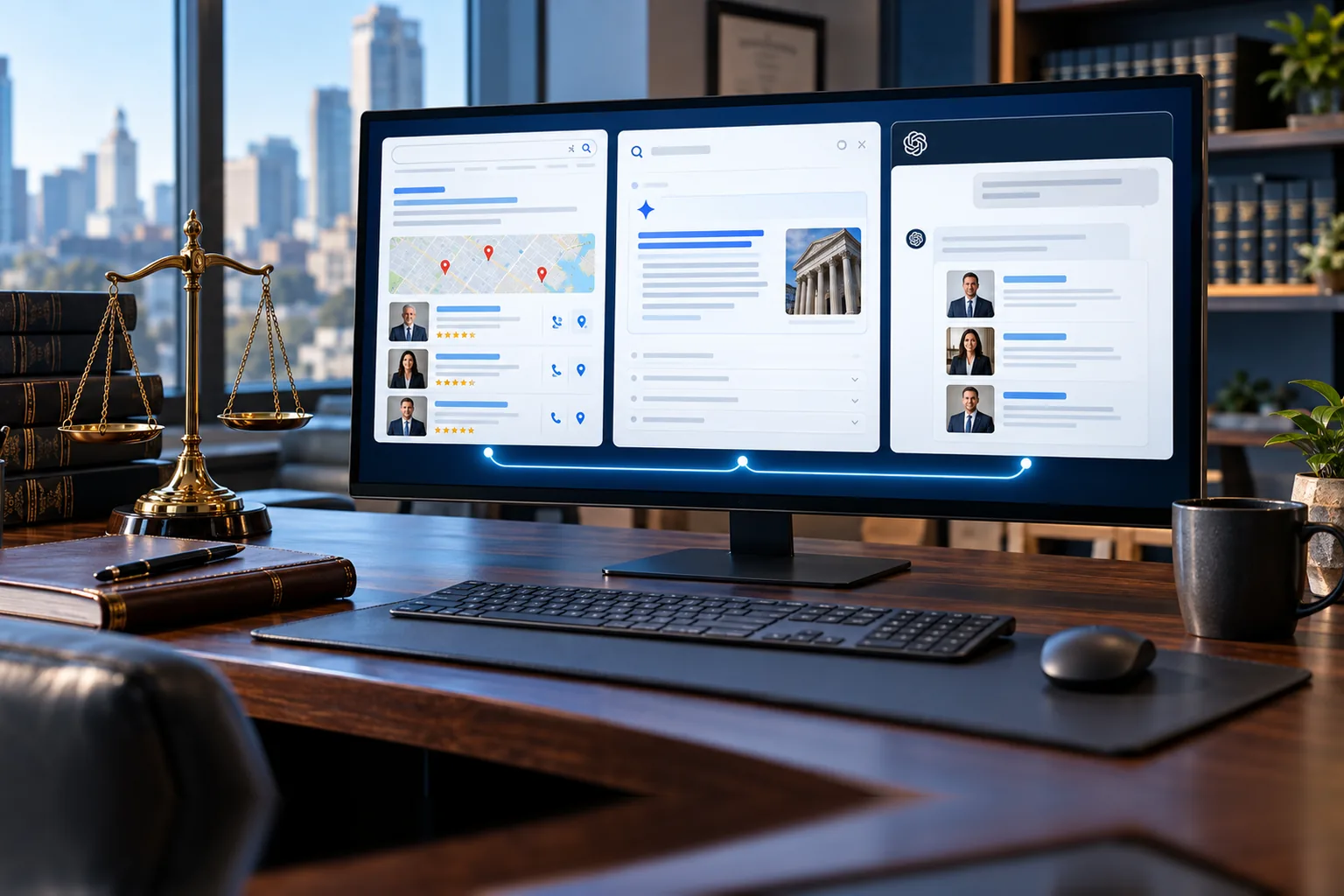
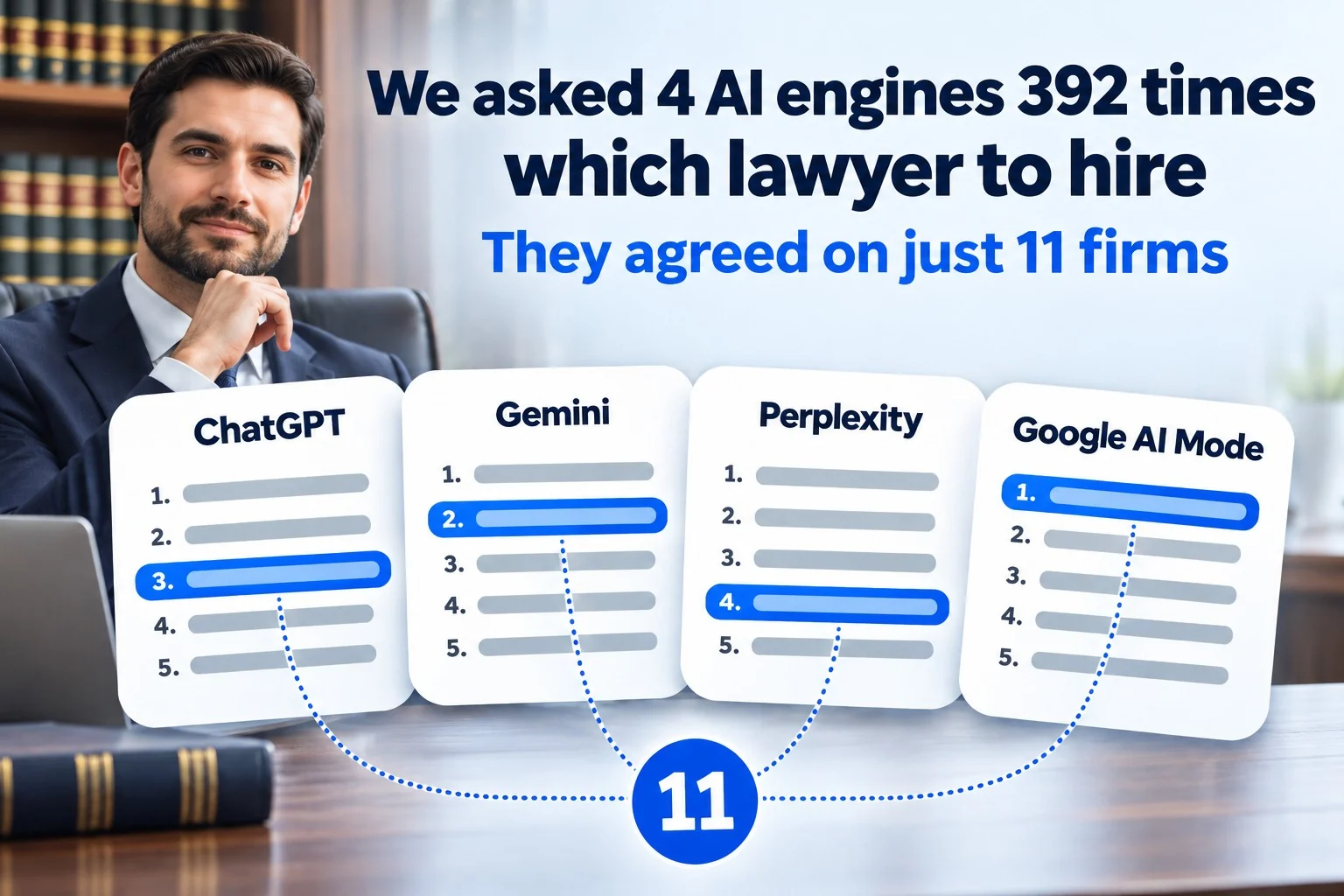
Short answer: they mostly recommend different lawyers. I put the same 100 client questions to ChatGPT, Gemini, Perplexity and Google AI Mode, covering five practice areas in ten of the largest US cities. For the questions that asked for the best lawyer, the four engines named 843 different firms between them, and only 11 of those firms were named by all four. If your firm shows up in one AI engine, that says very little about the other three.
I'm Ashikur Rahman, founder of Proximity Ranker. I've worked in SEO since 2017, including as former SEO Manager at Doctor Rank, and I hold an LL.B and an LL.M. AI search is where I've spent most of my time since the answer engines arrived. On one law firm site I work on, Microsoft's own dashboard counted 208,400 AI citations in three months. I ran this study to put real numbers on a question every firm owner should ask: if one AI engine names us, are we covered? It's about search and marketing, not law, so nothing here is legal advice.
How was this study run?
On 18 November 2026 I asked each engine ten questions in each of ten cities: New York, Los Angeles, Chicago, Houston, Phoenix, Philadelphia, Dallas, Miami, Atlanta and San Diego. Every question was typed into a fresh, logged-out browser window, the way a member of the public would use the free versions. Each practice area got two questions: one that asks for the best lawyer, and one that describes a real situation the way a worried client would type it.
| Practice area | Best lawyer question | Situation question |
|---|---|---|
| Personal injury | best car accident lawyer in {city} | I was hurt in a car crash in {city}, who should I call? |
| Criminal defense | best DUI lawyer in {city} | I was arrested in {city} last night, which lawyer should I call? |
| Immigration | best immigration lawyer in {city} | which immigration lawyer in {city} handles green card interviews? |
| Family | best divorce lawyer in {city} | how do I find a child custody lawyer in {city}? |
| Estate planning | best estate planning lawyer in {city} | who can help me with probate in {city}? |
That's 400 questions in total, and 392 came back with a usable answer. Google showed a CAPTCHA for six of the San Diego questions in AI Mode, and two Perplexity answers asked me to sign in. Software pulled every firm name out of each answer, public bodies such as Legal Aid and public defender offices were left out, and I checked the name matching and the most-named firms against the saved screenshots by hand. The full method and its limits are at the end of this article, along with the data to download.
How often do AI engines agree on which lawyer to recommend?
Rarely. Take the 50 best lawyer questions, where every engine named at least one firm almost every time. Across those questions the four engines named 843 different firms. Most of them were named by one engine and no other.
- Named by 1 engine665 (79%)
- Named by 2 engines124 (15%)
- Named by 3 engines43 (5%)
- Named by all 411 (1.3%)
Same city, same practice area, same question, asked on the same day. Source: Proximity Ranker AI lawyer study, 18 Nov 2026.
That has a practical meaning for any firm owner who has typed their own practice into ChatGPT and found their name. It's good news, but it tells you almost nothing about what a client sees in Gemini, Perplexity or Google's AI Mode. In this study, a firm that appeared in one engine's answer had roughly a one in five chance of appearing in another engine's answer to the same question. Outside research points the same way: Ahrefs found that only 6.82% to 10% of the pages ChatGPT cites rank in Google's top 10, depending on the question. My guide to SEO vs AEO vs GEO for law firms explains why each engine needs its own check.
Which law firms did all four AI engines name?
Eleven firms were named by all four engines for the same best lawyer question. Being on this list isn't a judgment of anyone's quality, and leaving a firm off isn't either. It's simply what the four engines said on 18 November 2026.
| City | Question | Firm |
|---|---|---|
| New York | best immigration lawyer | Wildes & Weinberg |
| Los Angeles | best DUI lawyer | Kraut Law Group |
| Los Angeles | best DUI lawyer | The Law Offices of Hart J. Levin |
| Chicago | best estate planning lawyer | Peck Ritchey |
| Houston | best car accident lawyer | Zehl & Associates |
| Philadelphia | best DUI lawyer | Law Offices of Steven E. Kellis |
| Philadelphia | best immigration lawyer | Palladino, Isbell & Casazza |
| Philadelphia | best immigration lawyer | Green and Spiegel |
| Philadelphia | best divorce lawyer | Petrelli Previtera |
| Atlanta | best immigration lawyer | Garvish Immigration Law Group |
| Atlanta | best divorce lawyer | Naggiar & Sarif |
Philadelphia had four of the eleven, and three of them were in immigration and family law. Not one of the eleven came from Miami, Phoenix, Dallas or San Diego, and none came from a personal injury question outside Houston.
Does the way a client asks change which lawyers AI names?
A great deal. When the question asked for the best lawyer, a firm was named in 99% of answers. When the question described a real situation, firms were named in 63% of answers. The rest gave the reader steps, checklists or a referral service instead of names.
- ChatGPT86%
- Gemini70%
- Google AI Mode62%
- Perplexity33%
Situation questions such as 'I was arrested in Chicago last night, which lawyer should I call?' 195 answers. For the 'best lawyer' questions the figure was 99% overall.
Here's one example. Asked "I was arrested in New York last night, which lawyer should I call?", ChatGPT named four criminal defense firms. Perplexity, asked the same question on the same day, named none. It gave the reader steps for the first few hours and pointed to Legal Aid and the state bar. Both answers are reasonable. But only one of them sends a caller to a private firm.
This matters because real clients rarely type "best DUI lawyer". They type what happened to them, and they do look before they call: Martindale-Avvo's 2026 legal consumer research found that 92.4% of people research before they contact a lawyer. Most law firm SEO targets the best lawyer and near me phrases, and those are exactly the questions where every engine hands out names freely. The situation questions are harder to win, and for some engines a firm can only win them by being the source the answer is built from. My guide to an AEO strategy for law firms shows how to map those questions to pages.
Which AI engine names law firms most often?
ChatGPT named at least one firm in 93% of its answers, Gemini in 85%, Google AI Mode in 81% and Perplexity in 65%. When they did name firms, Gemini gave the longest lists at 5.6 firms on average, followed by Perplexity at 4.9, ChatGPT at 4.7 and AI Mode at 4.5.
- ChatGPT93%
- Gemini85%
- Google AI Mode81%
- Perplexity65%
All 392 answers, both question types. Logged-out free versions, 18 Nov 2026.
The engines also build their answers differently. In 57 of its 94 answers, Google AI Mode, which Google opened to everyone in the US in May 2025, showed map listings with star ratings and directions, the same cards a client sees in Google Maps. Google says its local results weigh relevance, distance and prominence, which is why a complete Google Business Profile matters so much here. ChatGPT, which has searched the web live since OpenAI added search in October 2024, showed ratings or review counts next to the firms in 46 of its 100 answers. Perplexity leaned on ranking lists and roundup articles, such as Forbes and Best Lawyers lists, and was the most likely to say there's no objective "best" lawyer (15 answers, against 6 for Gemini and none for the other two).
Which practice areas get the most firm names in AI answers?
Immigration got firm names in every one of its 78 answers, for both question types. Personal injury came last. Its best lawyer questions named firms every time, but the crash question got names in only 12 of 40 answers. The engines mostly answered it with safety and insurance steps.
- Immigration100%
- Criminal defense86%
- Estate planning86%
- Family69%
- Personal injury65%
Both question types, all four engines, 392 answers.
Family law had the same split on a smaller scale: names in 38 of 39 best divorce lawyer answers, but in only 16 of 39 answers about finding a custody lawyer. If you run a personal injury or family firm, the pages that answer what happened to the client are where the opportunity is, because that's where most AI answers still don't name anyone. Criminal defense and estate planning sat in between, at 86% each.
Which directories does each AI engine lean on?
Every engine mentioned outside sources, but not the same ones. The table counts the answers that named each source in the answer text, either as where the information came from or as a place the reader should check.
| Source | ChatGPT | Gemini | Perplexity | Google AI Mode |
|---|---|---|---|---|
| Avvo | 40 | 16 | 12 | 4 |
| Super Lawyers | 2 | 48 | 18 | 18 |
| Justia | 2 | 25 | 33 | 5 |
| Best Lawyers | 5 | 13 | 29 | 6 |
| State bar or bar association | 21 | 44 | 26 | 29 |
| Google reviews or rating | 10 | 0 | 10 | 1 |
| Expertise.com | 5 | 14 | 5 | 3 |
| Forbes | 0 | 1 | 8 | 0 |
So no single directory covers all four engines. In this sample, ChatGPT's answers came back to Avvo, Gemini's to Super Lawyers and Justia, and Perplexity's to Justia and Best Lawyers, while AI Mode relied on its own map listings. A firm whose Avvo profile is thin will feel it in ChatGPT; a firm missing from Justia will feel it in Perplexity and Gemini. My guide on whether legal directories like Avvo and Justia are worth it goes through which ones to claim first. The pattern matches BrightLocal's study of ChatGPT's local answers, where business websites made up 58% of the sources, mentions on other sites 27% and directories 15%.
What does this mean for a law firm that wants to be named?
It means "AI search" isn't one channel, and treating it as one leaves most of the picture unchecked. Based on this data, this is the order I'd work in.
- Check all four engines, not one. A firm named by ChatGPT had about a one in five chance of being named by any other engine for the same question.
- Match your directories to the engines your clients use: Avvo for ChatGPT, Super Lawyers and Justia for Gemini, Justia and Best Lawyers for Perplexity, and a complete Google Business Profile for AI Mode.
- Keep your firm's name, address, phone and lawyers identical everywhere. An engine that finds two versions of your firm has a reason to name someone else, and schema markup that links your profiles helps it join them up.
- Write pages that answer what happened to the client, not only best lawyer pages. Situation questions are where most AI answers still name nobody.
- Check again every month. The same Houston question, asked about two and a half hours apart, came back with a different list in every engine.
None of this needs a separate AI package. It's the same identity, directory and page work that good local SEO has always involved, measured against four new scoreboards instead of one. My guide on how law firms get recommended by ChatGPT covers the page side in more detail.
How can you check what AI engines say about your firm?
You can repeat a small version of this study yourself in about twenty minutes.
- Open a private or incognito window so your own history doesn't shape the answer, and stay logged out.
- Ask two questions for your main practice area: one best lawyer question and one situation question, both with your city in them.
- Ask both in ChatGPT, Gemini, Perplexity and Google AI Mode (on google.com, choose AI Mode).
- Write down every firm named, the sources each answer mentions, and the date. Take a screenshot of each answer.
- Note which engines leave you out, and which directories they mention instead. That list is your to-do list.
Want this done properly for your firm, across 30 to 50 client questions in all four engines?
Get the auditWhat does it cost to have this checked and fixed?
The audit runs your clients' questions through the AI engines, lists who gets named instead of you and why, and ranks the fixes. It costs $350 for one office or $550 for two, and the fee comes off your first month if you start the SEO plan within 30 days. The plan itself is $799 a month for the first five firms, a rate that stays as long as you do, and $1,199 after that. AI search is part of the plan, not an add-on, and the audit is free on it. Every price is on the pricing page, and the method is on the AI SEO for lawyers page.
What else do law firm owners ask?
01Why does ChatGPT name my competitor but not my firm?
Usually because the sources ChatGPT reads describe your competitor more clearly. In this study ChatGPT mentioned Avvo in 40 of its 100 answers and often quoted ratings and review counts, so a competitor with a complete Avvo profile and more reviews that name the practice has an advantage. Check what ChatGPT cites for your question, then compare your listing on those sources with theirs. My guide on getting more Google reviews for a law firm covers the review side.
02Does Google AI Mode use my Google Business Profile?
It showed map listings in most of its answers. In 57 of the 94 AI Mode answers in this study, the firms came with star ratings and directions, the same cards a client sees in Google Maps. A complete, accurate Business Profile with steady reviews is the most direct way to be in those cards.
03How often do AI answers about lawyers change?
Often enough that one check isn't enough. I asked the Houston car accident question twice on the same day, about two and a half hours apart. ChatGPT kept four of its five firms, Perplexity kept four of six, Google AI Mode kept all three of its first names and added two, and Gemini kept only two of five. Check every month and judge the trend, not a single answer.
04Can I use this data in my own article or presentation?
Yes. The full list of firms named, by city, practice area and engine, is free to download as a CSV. Please link back to this page as the source.
05Will you run this check for my city and practice area?
Yes, that's what the audit does, with 30 to 50 of your own clients' questions instead of two. You get every answer, who was named instead of you, and the fixes in order.
What are the limits of this study, and can you download the data?
- Dates: all answers were captured on 18 November 2026 (US time). AI answers change, so treat this as a snapshot.
- Versions: the free, logged-out versions of each engine. Gemini showed its model as Flash-Lite in 94 of its 100 answers. Signed-in or paid versions can answer differently.
- Location: the questions were sent from Bangladesh, with the city written into every question. A searcher inside the city may see different local results, especially in Google AI Mode.
- Coverage: one run per question. 392 of 400 answers were usable (AI Mode 94, ChatGPT 100, Perplexity 98, Gemini 100).
- Names: firm names were extracted from each answer with software, then matched within each city and practice area. I checked the matching by hand, and every firm in the all-four table against the saved answers.
- Directory counts are mentions in the answer text, not a count of the links each engine cited.
- Not measured yet: how the named firms compare on Google Maps rankings and review counts. That comparison is planned as an update to this page.
- Data: download the full list of firms named (CSV).