
Short answer: an AEO strategy for a law firm includes a map of the questions clients ask before they hire a lawyer, one page that answers each important question in its first lines, a firm identity that reads the same everywhere online, lawyer and proof details an engine can verify, structured data, AI crawler access, and a monthly check of whether Google and the AI tools actually use your answers. It's written down before any page gets touched, so every change has a reason and a way to be measured.
I'm Ashikur Rahman, founder of Proximity Ranker, an SEO and AI search specialist with legal training (an LL.B and an LL.M). I build these plans for law firms only. One new New York law firm site I worked on earned 104,000 impressions on Google in its first three months. I'll stay on the search side throughout: this is about how a firm's answers get found and chosen, not about any rule of law.
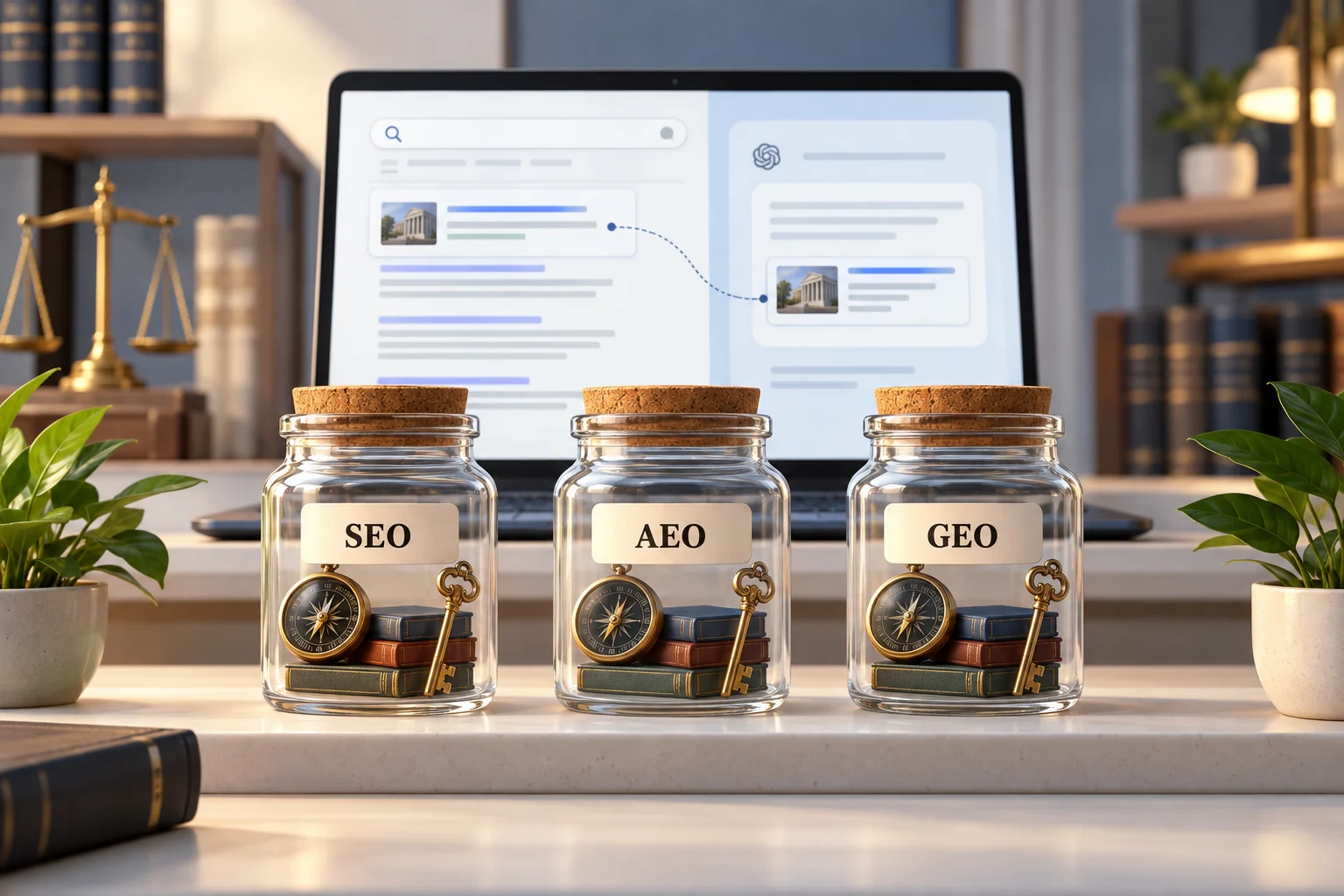
AEO stands for answer engine optimization: getting your page chosen as the answer, whether that's Google's answer box, a voice assistant or an AI tool. If you're still sorting out the terms, my guide to the difference between SEO, AEO and GEO sets them side by side.
What is an AEO strategy, and how is it different from AEO tactics?
Tactics are the individual moves: adding FAQ markup, rewriting an intro, claiming a directory listing. A strategy decides which questions matter, in what order to answer them, which page owns each one and how you'll know it worked. Without that, firms end up doing the easy tactic everywhere and the important one nowhere.
The most common version I see is an FAQ block pasted under every practice page with the same six generic questions. That used to earn expandable FAQ results in Google. Google stopped showing those in May 2026, and generic answers were never what AI tools quote. A strategy starts from the opposite end: the specific questions your clients ask and the single best page to answer each one.
Which questions should a law firm's AEO strategy target?
Your clients have already told you. The job is collecting their questions in their words, from four places.
- Intake: for one month, have whoever answers the phone write down the first question each caller asks. It's the most accurate question research a firm can do, and nobody else has it.
- Search Console: filter your queries for words like how, what, can, should, cost and near me. Questions with impressions but a poor position are pages you nearly have; questions with no matching page are gaps.
- Google and the AI tools: the People Also Ask boxes for your main case types, and the follow-up questions ChatGPT, Perplexity and Google's AI Mode suggest after an answer, show where a conversation goes next.
- Your reviews: the words clients use to describe their problem and what you did are the words the next client will type.
Then sort the questions by the moment the client is in, because each group needs a different kind of page.
- The problem: do I need a lawyer for this, what happens next, how long does it take. These belong on your case-type pages, and your lawyers should write or approve every answer.
- The choice: how do I choose a lawyer for this, what should I ask at a consultation, what's the difference between a small firm and a big one. These are the questions where a firm can show how it works.
- The cost: how much does this kind of lawyer charge, is the consultation free, are there payment plans. Clients ask these constantly and many firms avoid them, which is exactly why a clear page gets quoted.
- The place: best lawyer for this in my city, a lawyer near me who speaks my language, a lawyer open on weekends. These lean on your Business Profile and location details as much as your pages.
A workable map for a single-practice firm usually holds 30 to 50 questions. Rank them by how often clients ask them and how much a client from that question is worth to the firm, and start at the top.
How should a law firm page answer a question for AEO?
Answer engines lift passages, so each passage has to stand on its own. The format I use on every question page:
- A heading that is the question, phrased the way clients ask it, not the way a lawyer would title it.
- The answer in the first two or three sentences, roughly 40 to 60 words, before any background. If the honest answer is it depends, say what it depends on.
- The detail after that: the steps, the factors, a short example, and a table when the question compares options or costs.
- A named lawyer as the author or reviewer, linked to a bio, with the date the page was last reviewed.
- Links to the related questions, so the page sits inside a cluster instead of floating alone.
One caution. It's tempting to spin up a separate page for every variation of every question. Don't. Google's spam policies call pages produced at scale mainly to manipulate rankings scaled content abuse, and a site full of near-duplicate pages looks less trustworthy to every engine. One strong page per real question, answering its close variations inside it, does better.
Why does the firm's identity matter to answer engines?
An engine doesn't only judge a page; it judges whether the firm behind it is real and who it says it is. It builds that picture by connecting the firm's name, lawyers, address, phone, practice areas and profiles across the web into a single entity. When those details agree everywhere, the engine can cite you with confidence. When your website lists one address, your Business Profile another and an old directory a third, it hedges or picks a firm it's surer about.
The places to check for a law firm: your website, Google Business Profile, Bing Places, your bar or law society listing, Avvo, Justia, FindLaw, Martindale, Super Lawyers, LinkedIn for the firm and each lawyer, and any local chamber or association pages. On your own site, link to those profiles from your structured data so engines can join the dots. It matters for AI tools in particular: in BrightLocal's study of ChatGPT's local answers, directories and mentions on other sites made up 42% of the sources between them.
What proof and authorship do answer engines look for?
Google's Search Quality Rater Guidelines treat trust as the most important part of E-E-A-T (experience, expertise, authoritativeness and trust), and they hold topics that can affect someone's money, safety or legal situation to the highest standard. Legal questions sit squarely in that group. The raters don't set rankings directly, but the guidelines describe what Google's systems are built to reward.
In practice, that means each answer should carry signals an engine can check: who wrote it, what that lawyer's admissions and years in practice are, which case types they handle, and dated results where you're allowed to publish them. The research behind GEO points the same way: in the Princeton-led study of AI answers, adding citations, quotations and statistics was what raised a source's visibility, by up to 40% in their benchmark. Specific, sourced and attributed beats polished and vague.
Reviews count here too. A review that names the kind of case and what the lawyer did gives an engine a sentence it can repeat. My guide on getting more Google reviews for a law firm covers how to ask for those without breaking platform rules.
What structured data belongs in a law firm's AEO strategy?
- LegalService for the firm, with its name, address, phone, opening hours, areas served and sameAs links to its profiles. Schema.org marks the older Attorney type as deprecated and points to LegalService instead.
- Person for each lawyer, with job title, education, memberships and the subjects they know, linked to the firm.
- FAQPage only on sections that really are questions and answers. Google no longer shows FAQ rich results, but it still reads the markup to understand the page.
- BlogPosting or Article on guides, with the author set to the named lawyer. BreadcrumbList on every page shows the engine where each one sits.
Every value in the markup has to match what's visible on the page. Markup that claims things the page doesn't show is a reason to distrust it, not to cite it.
Can answer engines actually read your law firm's website?
This is the step most AEO plans skip, and it can quietly cancel all the rest. Three checks:
- Rendering: Googlebot runs JavaScript, but the crawlers behind ChatGPT and Claude don't, according to research by Vercel and MERJ. View your page with JavaScript switched off. If the answers vanish, those engines can't see them.
- Access: read your robots.txt and your firewall settings. Cloudflare began blocking known AI crawlers by default on new domains in July 2025, and many firms have that switch on without knowing it. OAI-SearchBot (ChatGPT search), PerplexityBot and Bingbot need to get through if you want those engines to use your pages.
- Freshness: submit your sitemap in Google Search Console and Bing Webmaster Tools, and use IndexNow to tell Bing about updated pages. Copilot answers from Bing's index, so a page Bing hasn't recrawled can't be quoted in its new form.
How do you measure whether an AEO strategy is working?
- A fixed question set: put the same 30 to 50 questions from your map to ChatGPT, Gemini, Perplexity and Google every month, logged out, and record whether your firm is named and which page is cited.
- Bing Webmaster Tools AI Performance: in public preview since February 2026, it counts how often Copilot and Bing's AI summaries cite your pages and shows the questions behind those citations.
- Google Search Console: the generative AI report, live since June 2026, shows impressions your pages earned in AI Overviews and AI Mode. In the regular Performance report, filter for question queries and watch their positions.
- Intake: add AI assistants as an answer to how did you hear about us. It's the number that ties all of this to signed clients.
What does the first 90 days of a law firm AEO strategy look like?
- Weeks 1 and 2: the audit. Build the question map, run the baseline question set through the engines, check rendering, robots.txt and firewall access, and pull the Search Console and Bing numbers you'll compare against.
- Weeks 3 to 6: rewrite the ten most valuable question pages answer-first, add named lawyer authors and review dates, and fix the structured data.
- Weeks 5 to 10: bring the firm's details into line across the Business Profile, directories and bar or law society listings, and start asking clients for reviews that describe their case type.
- Weeks 8 to 12: write pages for the high-value questions you had no answer for, link each cluster together and send the first report with all the numbers next to the baseline.
Set expectations honestly. Crawlers can pick up a rewritten page within days or weeks, but the identity, review and mention work builds over months. Judge the trend across three months, not a single answer on a single day.
Want your firm's question map and baseline built for you?
Get the auditWhat does an AEO strategy cost for a law firm?
AEO is part of my SEO plan rather than a separate retainer. The plan costs $799 a month, month to month, and includes local and on-page SEO, Google Business Profile optimization, AI search optimization (the AEO and GEO work in this guide) and a monthly report. On the plan, the audit, negative review removal and Google Ads management cost nothing extra, and a new website is free once you commit to six months.
If you'd like the strategy before deciding on monthly work, the audit is $350 for one office or $550 for two. It includes the question map, the baseline across the AI engines and the list of fixes in order. On their own, a website starts at $799, review removal is $199 per review Google removes and Google Ads management is $499 a month. All of it is on the pricing page, and the method is on the AI search optimization page.
What else do law firm owners ask?
01Can a small law firm run its own AEO strategy?
Yes, much of it. The question map, the answer-first rewrites and the monthly question checks need time more than tools, and your lawyers know the answers better than any agency. Where firms usually need help is the technical side (rendering, crawler access, structured data) and the identity cleanup across dozens of directories, which is slow and easy to get wrong.
02Is an AEO strategy for Google different from one for ChatGPT?
The core is the same: clear answers, a consistent firm identity and proof. The differences are in the plumbing. Google's AI features use Google's own index and your Business Profile, while ChatGPT search relies on its own crawler and web search results, and Copilot uses Bing. That's why the crawler and indexing checks cover all of them. For the Google side in detail, see how law firms show up in Google AI Overviews.
03Should every page on a law firm website have an FAQ section?
No. Add questions where clients genuinely ask them about that page's subject, answer them properly, and leave the rest out. Six generic questions repeated across twenty pages add nothing, and Google stopped showing FAQ rich results in May 2026, so there's no visual reward for them either.
04What should a law firm avoid in an AEO strategy?
Promising outcomes, publishing results you aren't permitted to publish under the advertising rules of your bar or law society, AI-written pages no lawyer has read, fake or incentivized reviews, and copying a competitor's answers. Each of these either breaks a rule or makes the firm less credible to the engines it's trying to impress.
05How often should a law firm update its answers?
Review the question pages every quarter and whenever something in them changes, such as your fees, your team, your office hours or how you take new cases. Put the last-reviewed date on the page. Engines and clients both prefer an answer they can see is current.