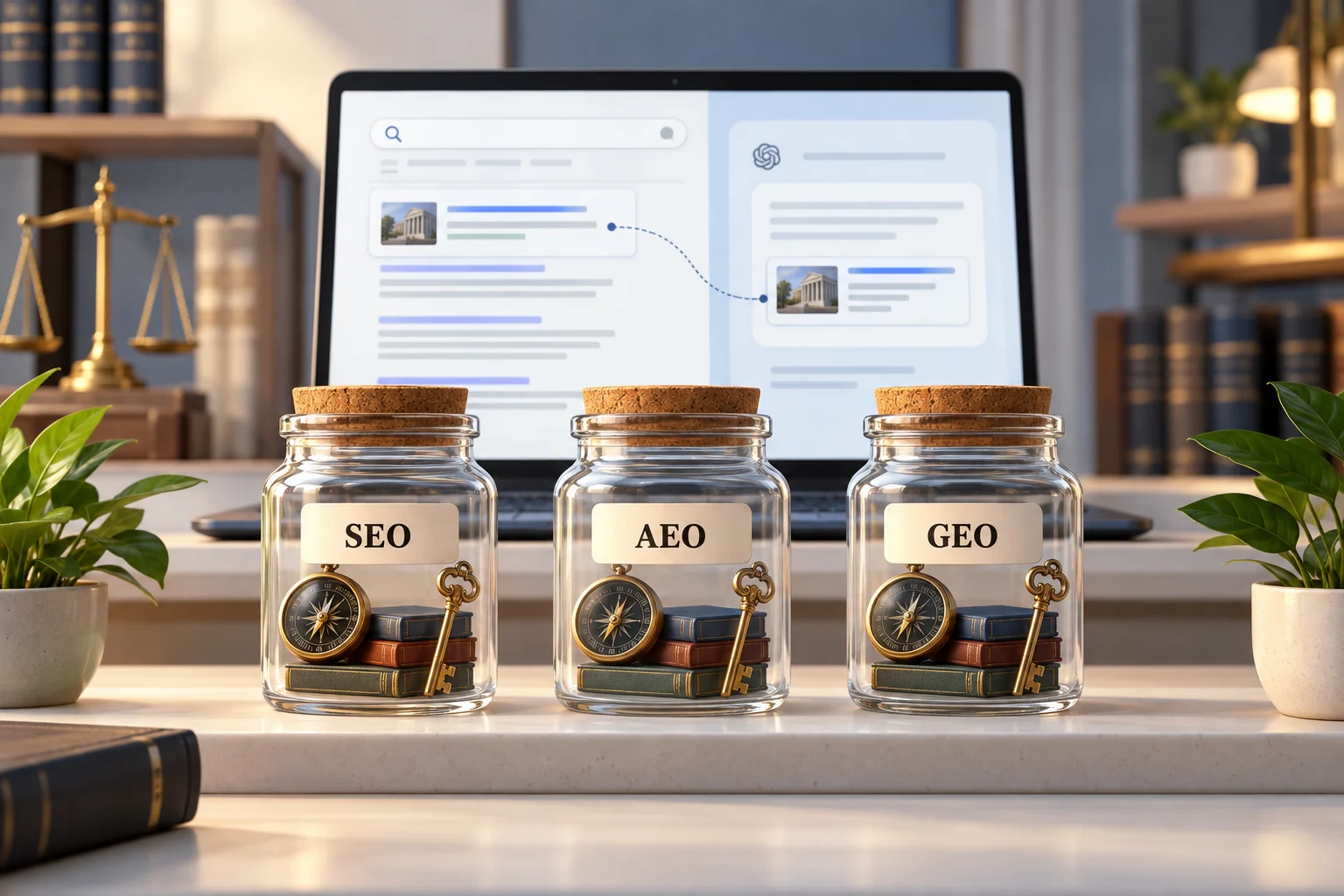

Short answer: SEO gets your law firm into Google's list of results, AEO (answer engine optimization) gets your page chosen as the direct answer to a client's question, and GEO (generative engine optimization) gets your firm named inside the answers that ChatGPT, Gemini, Perplexity, Copilot and Google's AI Overviews write. All three stand on the same foundation, a website search engines can crawl, understand and trust. They differ in what a win looks like and how you measure it, and a firm doesn't need three agencies or three budgets to cover them.
I'm Ashikur Rahman, founder of Proximity Ranker. I'm an SEO and AI search specialist with legal training, an LL.B and an LL.M, and I work only with law firms. For one personal injury firm, my work brought 23,300 clicks from Google in six months. For another, it led to 208,400 citations by Microsoft's AI assistants in three months. Those two numbers come from the same kind of work, measured two different ways, and that is really what this guide is about. My work is search, so nothing below is legal advice. It's about how clients find a firm and decide to call it.
Why are there three names for getting a law firm found?
Because search has changed shape three times, and marketers named each shape. Search engine optimization is the oldest; Danny Sullivan, who founded Search Engine Watch, traced the first uses of the phrase to 1997. Back then a search returned ten blue links, and the job was to be one of them.
Then Google started answering questions on the results page itself, with featured snippets and People Also Ask boxes, and voice assistants began reading a single answer out loud. Winning that one answer got its own name: answer engine optimization.
The third shape arrived when software started writing the answer. ChatGPT added web search, Perplexity built a whole product on cited answers, and Google launched AI Overviews in the United States on May 14, 2024, after a year of testing them as the Search Generative Experience. In November 2023, a team led by researchers at Princeton published a paper that named the work of showing up in those written answers generative engine optimization.
So the three names follow the format of the search results, not three separate crafts. You'll also hear AI SEO, AIO and LLMO. They're labels for the same family of work, which is why my guide to getting recommended by ChatGPT calls AEO and GEO one job. The difference worth understanding is where each one shows up and how you know it's working.
What is SEO for a law firm?
SEO is the work that gets Google to rank your pages when someone searches for a lawyer or a legal problem. For a law firm it has four parts.
- Technical: Google can crawl every page, the pages get indexed, they load fast on a phone, and nothing in the code blocks them.
- Content: a page for each practice area and each case type you actually take, written in the words clients search with, not the words lawyers use with each other.
- Authority: links and mentions from other sites, legal directories and local press that tell Google other people vouch for you.
- Local: a complete Google Business Profile with the right categories, real reviews and the same name, address and phone everywhere. Google says it ranks local results on relevance, distance and prominence, and the map pack is where many people pick a firm without ever scrolling to the website links.
A win in SEO is visible and countable: positions, map pack placements, clicks and calls. You measure it in Google Search Console and in the Performance tab of your Business Profile. For one Queens injury firm I work with, the profile brought in 70 calls in June 2026, 25% more than in June 2025.
What is AEO (answer engine optimization) for a law firm?
AEO is about the single answer. When a person asks a question, Google, a voice assistant or an AI tool often picks one passage and puts it in front of everything else. AEO is the work of making your page the one it picks.
The questions are the ones your intake team hears every week: how much does a car accident lawyer cost, what should I bring to a divorce consultation, can I talk to a lawyer for free, how do I choose a criminal defense lawyer. The work is finding those questions, giving each one a heading in your clients' words, answering it plainly in the first two or three sentences and only then going into detail. It also means structured data, the code that labels your firm as a LegalService and each lawyer as a Person, so machines can tell who is answering.
One thing has changed this year. Google stopped showing FAQ rich results, the expandable questions under a search listing, in May 2026. It still reads FAQ markup to understand a page, but an FAQ block pasted on every page no longer earns anything you can see. AEO now lives or dies on whether the answer itself is the best one available.
A win in AEO is your sentence being the one shown or read out. You measure it through question searches in Search Console, which question boxes you appear in, and whether AI tools quote your wording.
What is GEO (generative engine optimization) for a law firm?
GEO is about answers that a machine writes. When someone asks ChatGPT or Google's AI Mode to recommend a family lawyer, the engine doesn't hand back a list. It runs several searches of its own, reads a handful of sources and writes a paragraph that names two or three firms. Google calls the first step query fan-out. GEO is the work of being one of those sources and one of those names.
The Princeton-led paper is still the best evidence on what moves it. The researchers built a benchmark of 10,000 queries and tested ways of rewriting source pages. Adding citations to credible sources, quotations and statistics raised a page's visibility in the generated answers by up to 40%, while the old trick of repeating keywords did little. They also found the results differed by subject, which matches what I see: a law firm's page earns citations through specifics, such as a named lawyer, a dated result or a clear fee explanation, not through repetition.
GEO also reaches well past your own website. In BrightLocal's study of ChatGPT's local answers, business websites made up 58% of the sources, mentions on other sites 27% and directories 15%. For a law firm, that means your bar or law society listing, Avvo, Justia, Super Lawyers, local news quotes and your reviews all feed the answer.
And the engines have to be able to read you. Research by Vercel and MERJ found that the crawlers behind ChatGPT and Claude download JavaScript but don't run it, so a site that only shows its text after scripts load looks empty to them. A firewall can block them too.
A win in GEO is being named or cited in AI answers. You measure it with the AI Performance report in Bing Webmaster Tools, which is where my 208,400 figure comes from, Google Search Console's generative AI report, a fixed set of client questions you put to the engines every month, and a line on your intake form asking how the client heard about you.
How do SEO, AEO and GEO compare side by side?
- Where your firm shows up. SEO: the list of results and the map pack. AEO: the one answer above the results, in a question box, or read aloud. GEO: inside a written answer from ChatGPT, Gemini, Perplexity, Copilot or Google's AI.
- What a win looks like. SEO: a high position and a click. AEO: your wording chosen as the answer. GEO: your firm named as a recommendation or cited as a source, often with no click at all.
- What the work leans on. SEO: crawlable pages, case-type content, links and the Business Profile. AEO: question research and answer-first writing. GEO: proof the engine can check, a consistent identity across the web and pages AI crawlers can read.
- How you measure it. SEO: Search Console, rankings, calls and form fills. AEO: question queries and answer boxes held. GEO: Bing's AI Performance report, Google's generative AI report, monthly prompt checks and intake answers.
- How fast it moves. A page fix can be picked up within days or weeks in all three. Authority, reviews and mentions on other sites build over months, and GEO depends on those the most.
Does a law firm still need SEO if clients are asking ChatGPT?
Yes, and Google says so itself. Its documentation on AI features says AI Overviews and AI Mode are built on the same core ranking and quality systems as regular Search, and that a page only needs to be indexed and eligible for a snippet to be used as a supporting link. There's no separate AI application to fill in. If Google can't find, index or trust a page, no AI layer will rescue it. My guide on how law firms show up in Google AI Overviews covers the Google side step by step.
What has changed is what ranking buys you. Pew Research Center tracked the browsing of 900 American adults and found that when Google showed an AI summary, people clicked a regular result on 8% of visits, against 15% when there was no summary. Only 1% clicked a link inside the summary. The firm that's named in the summary gets remembered, and often gets the call, even when nobody clicks.
Clients haven't stopped researching, either. Martindale-Avvo's 2026 legal consumer research found that 92.4% of people research before they contact a lawyer, and OpenAI said in February 2026 that ChatGPT had 900 million weekly users. A growing share of that research now ends in an answer rather than a list of links, so SEO gets you considered and AEO and GEO decide whether you're the name that comes up.
Which one should a law firm start with?
Start with the foundation, then build up, but run it as one plan, because the same page does all three jobs. This is the order I use.
- Fix what stops you being found: pages that aren't indexed, a slow phone experience, JavaScript-only pages, blocked AI crawlers, one generic practice areas page standing in for ten case types.
- Give every case type and every common client question its own page, with the answer in the first lines and a named lawyer behind it.
- Clean up your identity across the web: the same firm name, lawyers, address, phone and practice areas on your site, your Business Profile, your bar or law society listing and every legal directory.
- Build proof an engine can check: lawyer bios with admissions and years in practice, dated case results, and reviews in which clients describe the kind of case you handled.
- Measure all three every month from the real dashboards, not from screenshots chosen to look good.
Take a car accident page as an example. It ranks for car accident lawyer searches in your city, which is SEO. It opens with a two-sentence answer to how much a car accident lawyer costs, which is AEO. And it names the lawyer who handles these cases, lists dated results and matches the firm details on Avvo and the Business Profile, which is what lets ChatGPT and Google's AI cite it with confidence, which is GEO. One page, three results.
When you're comparing agencies, three things are worth watching for: separate retainers for AEO and GEO on top of SEO, any guarantee that ChatGPT will recommend your firm (no one controls that), and reports that show rankings but never the AI numbers. My guide on how to choose an SEO company for a law firm covers the rest of that checklist.
Want to see where your firm stands in Google, the answer boxes and the AI engines?
Get the auditWhat does SEO, AEO and GEO cost for a law firm?
I don't sell them separately. My SEO plan is $799 a month, month to month, and it covers all three: local and on-page SEO, Google Business Profile optimization, AI search optimization (AEO and GEO) and a monthly report with the Search Console, Business Profile and AI citation numbers side by side. The audit, negative review removal and Google Ads management come free on the plan, and a firm that stays six months gets a new website at no charge.
Bought on their own, the audit is $350 for one office or $550 for two, a website starts at $799, review removal is $199 for each review Google takes down and Google Ads management is $499 a month. The full list is on the pricing page. For how I approach each side, see SEO for lawyers and AI search optimization for lawyers.
What else do law firm owners ask?
01Are AIO, LLMO and AI SEO different from AEO and GEO?
No. AIO (AI optimization), LLMO (large language model optimization) and AI SEO are more names for the same family of work. Some agencies use a new label to sell a new package. Ask what the work actually is, which pages change and how it's measured. If the answer matches what's in this guide, it's the same job under a different name.
02Can a law firm pay to be recommended in ChatGPT or Google's AI answers?
Not in the answer itself. Google can show labeled ads near and inside AI Overviews, but the summary and the firms it names come from Google's organic systems. ChatGPT's answers draw on web search and the sources it finds. Anyone who promises a guaranteed spot in an AI recommendation is promising something they don't control.
03Will GEO replace SEO for law firms?
Not on current evidence. AI answers still depend on search indexes: Google's AI features run on its core ranking systems, and ChatGPT and Copilot pull from web search when they answer local questions. What's shrinking is the value of a ranking that nobody clicks. That's why a good plan now reports AI citations alongside rankings rather than instead of them.
04Does schema markup help with AEO and GEO?
It helps engines understand who you are, and that supports both. Use LegalService for the firm (schema.org now treats the older Attorney type as deprecated in favor of it), Person for each lawyer, and FAQPage only on real question and answer sections. The markup has to match what's visible on the page. On its own, schema won't get a weak page cited.
05Should a law firm create a separate page for every question an AI might ask?
No. Write one strong page per case type and per genuinely common question, and answer related questions inside it. Google's spam policies treat pages produced in bulk mainly to manipulate rankings as scaled content abuse, and thin near-duplicate pages make a firm look less trustworthy to every engine, not more.