
Short answer: most of what law firms are being sold as "AI search" is ordinary SEO with a new label, and a few of the add-ons do nothing at all. Google says its AI Overviews and AI Mode need no extra technical setup beyond being indexed, its staff have said no AI system uses llms.txt, and nobody can promise your firm a fixed spot in ChatGPT's answers. What does move AI visibility for a law firm is the same work that earns trust in regular search: clear pages, provable expertise and a good reputation on other sites.
I'm Ashikur Rahman, and I run Proximity Ranker, an agency that works only with law firms. I trained in law (an LL.B and an LL.M in International Law) before I went into search, and I've done SEO since 2017, including years as SEO Manager at Doctor Rank. In one three-month stretch, pages I optimized were cited 208,400 times by Microsoft's AI assistants, across 131 pages on average. I didn't buy a single AI add-on to get there. This guide is about marketing claims, not law, so treat it as a buyer's checklist and nothing more.
Here are the seven claims I hear most often from firm owners who've just sat through an agency pitch, and what the evidence says about each one.
Myth 1: Does a law firm need an llms.txt file to show up in AI answers?
No. An llms.txt file is a plain text file some people suggest putting at the root of a website to summarize it for large language models. It sounds technical, so it gets sold as a deliverable. Google's John Mueller wrote in June 2025 that no AI system currently uses it, and in June 2026 he called it "purely speculative for now." His point was simple: a file written by the site that wants to be chosen is self-reported, so an engine has little reason to trust it over the actual pages.
Adding one won't hurt your site. Paying for it as if it were the reason a firm gets cited in AI answers is the problem. If an AI proposal lists llms.txt as a headline item, ask what else is in the scope, because that file takes about ten minutes to write.
Myth 2: Is AEO or GEO a separate service from SEO?
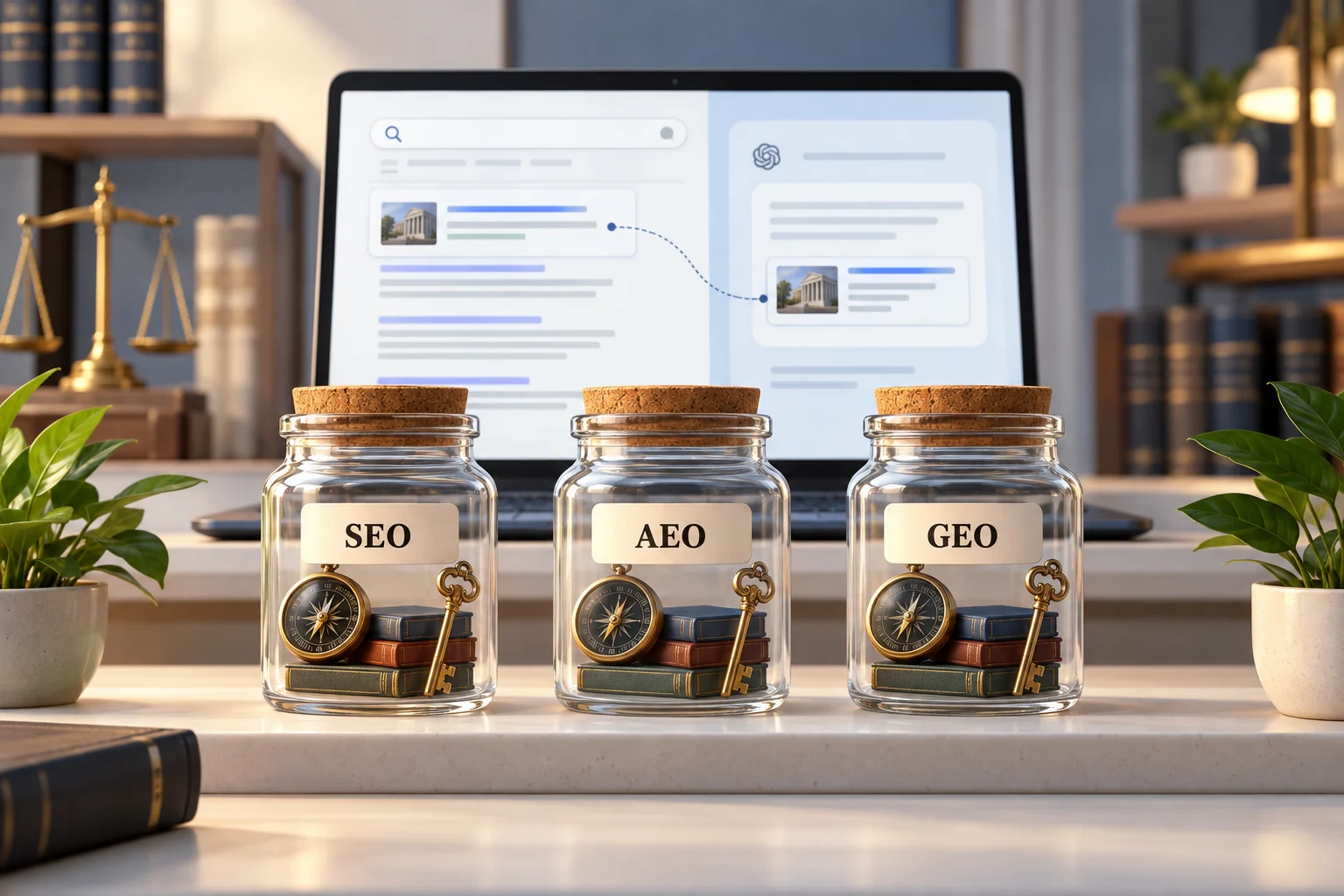
Not in any way that justifies a second retainer. Google's documentation on AI features says a page only has to be indexed and eligible to show a snippet in Search to be used as a supporting link in AI Overviews or AI Mode, with no additional technical requirements. Google's Danny Sullivan said it more bluntly at WordCamp US in August 2025: "good SEO is good GEO," and he joked through the list of new acronyms on the way.
There is a real difference in measurement. ChatGPT doesn't simply copy Google: Ahrefs found only 6.82% to 10% of the pages ChatGPT cites also sit in Google's top ten for the same search. So AI reporting deserves its own line in your monthly report. That's a reporting task inside one plan, not a reason to buy two. My guide on the difference between SEO, AEO and GEO walks through where each one shows up.
Agency playbooks for selling GEO openly describe it as an upsell to existing SEO clients, and one GEO pricing guide suggests adding 20% to 30% on top of the current retainer. If your current agency is already doing the work properly, that money buys a new name for it.
Myth 3: Is there special AI schema that gets a law firm cited?
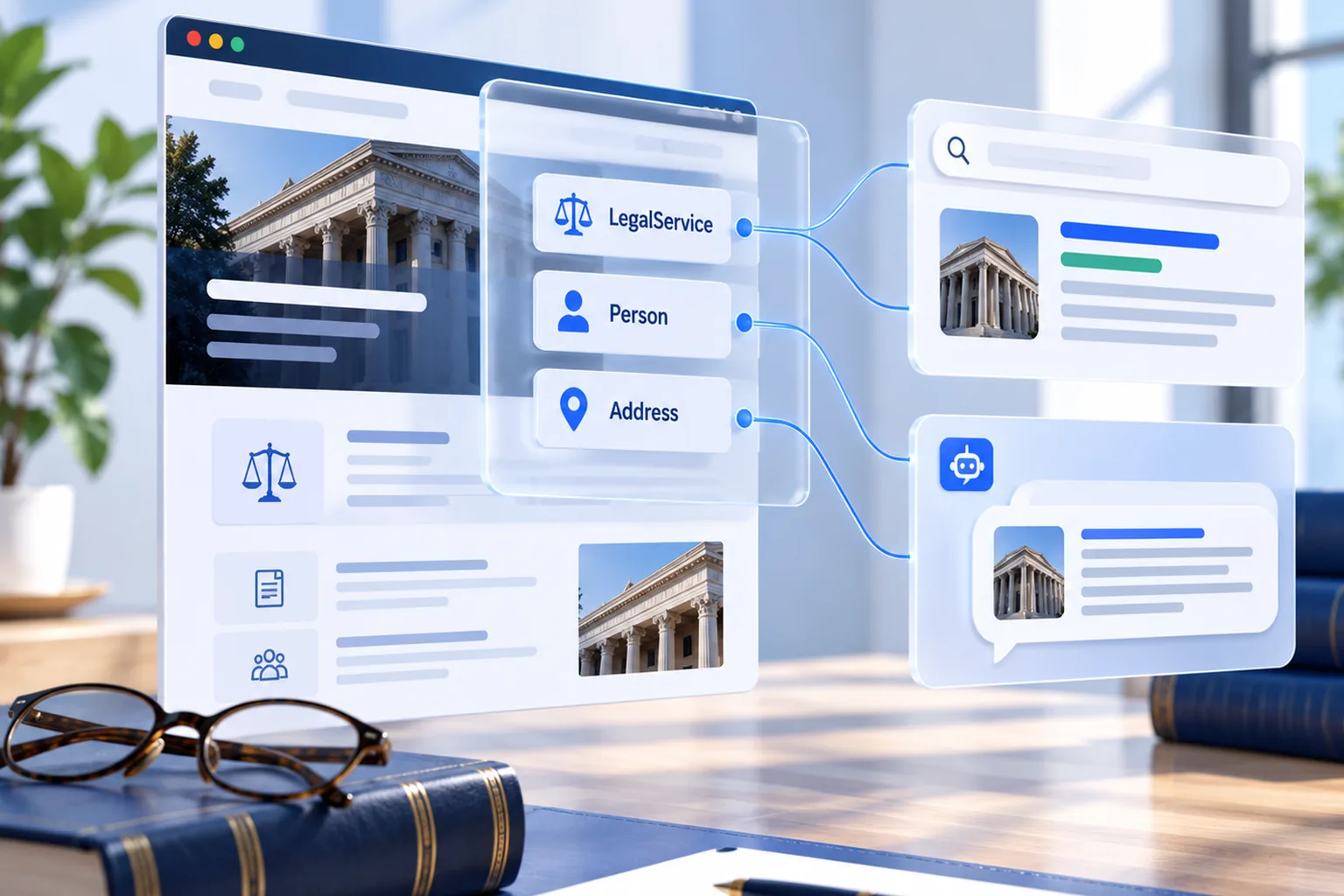
No. Structured data, the code that labels a page for machines, is useful: it tells engines that your firm is a LegalService, who each lawyer is and which questions a page answers. But Google's guidance on generative AI features says structured data isn't required to appear there and that there's no special schema.org type to add for it. Google's structured data rules also say markup has to describe content people can actually see on the page.
So be careful with "AI schema packages" that stuff hidden questions, reviews or service lists into the code. Markup that doesn't match the visible page breaks Google's rules, and it can't make a thin page worth quoting. Good schema describes a good page. It doesn't replace one.
Myth 4: Can an agency guarantee your firm a spot in ChatGPT?
No one can. ChatGPT, Gemini, Perplexity and Google's AI write a new answer every time, from whatever sources their search step pulls in at that moment. No agency has a contract with OpenAI or Google that places a firm inside those answers. What an agency can control is your side of it: whether your pages can be read, whether your facts match everywhere and whether there's enough proof about your firm for an engine to recommend it with confidence.
A guarantee is a warning sign, not a selling point. The honest version sounds like this: here's how often your firm is named today across a fixed set of client questions, here's the work, and here's how we'll report the change every month.
Myth 5: Do AI rank trackers show exactly where your firm ranks in ChatGPT?
They can't, because AI answers don't have fixed positions. In early 2026, SparkToro's Rand Fishkin and Gumshoe.ai's Patrick O'Donnell ran 2,961 prompts through ChatGPT, Claude and Google's AI, 60 to 100 times each. The chance of getting the same list of brands twice was less than 1 in 100, and the order and length of the lists changed too. The study wasn't peer reviewed, and the authors said so, but every firm that tests its own questions sees the same thing: ask twice, get two answers.
The same study found something useful, though. Some brands came up again and again across runs, which means visibility can be measured as a rate over many attempts. So a dashboard that says "you rank number 2 in ChatGPT" from one check is reporting noise. A report that runs the same questions many times and tracks how often your firm is named is reporting something real. I pair that with Bing Webmaster Tools' AI Performance report and Google Search Console's generative AI report, which come straight from the platforms.
Myth 6: Has AI killed SEO for law firms?
No, and people have been asking "will AI replace SEO" for three years now. Google said in early 2025 that it handles more than 5 trillion searches a year, its first update since the 2 trillion it reported in 2016. AI answers are built on top of search: Google's AI features run on its index, and ChatGPT runs its own web searches before it writes a local recommendation. A firm that search engines can't find, index or trust doesn't get into AI answers either.
What has changed is the value of a ranking nobody clicks. More questions now end in an answer at the top of the page, so the firm named in that answer gets remembered. That's why the map pack and reviews matter more, not less. For one Queens injury firm I work with, the Google Business Profile brought 70 calls in June 2026, 25% more than a year earlier. Those calls came from search, not from anything sold as AI.
Myth 7: Should you rewrite every page on your site as questions and answers?
No. Answering real client questions clearly is good practice, and opening a section with the direct answer helps both people and machines. But turning every practice page into a wall of FAQ blocks doesn't do that. Google stopped showing FAQ rich results in May 2026, so the visible reward is gone, and hundreds of near-identical question pages can look like content produced at scale to game rankings.
The better approach is one strong page per case type you actually take, with the questions clients really ask answered inside it, in their words. If a question deserves its own page, it's because people search it and the answer needs room, not because an AI checklist said so.
What actually gets a law firm named in AI search?
The work that's left once you strip out the myths is the work that has always earned trust, and legal topics get the strictest version of it. Google's Search Quality Rater Guidelines call trust the most important part of E-E-A-T (experience, expertise, authoritativeness and trust), and they hold topics like legal help to the highest standard. In practice, for a law firm, that comes down to four things.
- Intent clarity: each page answers one kind of client problem, in the words clients search with, so an engine can tell exactly what the page is for.
- Expertise you can check: named lawyers with real bios, admissions and years in practice, and dated results where your bar or law society's rules allow them.
- Consistency: the same firm name, lawyers, address, phone and practice areas on your site, your Business Profile, your bar listing and every directory.
- Reputation off your site: reviews, directory profiles, local press and mentions. In an Ahrefs study of 75,000 brands, mentions on other websites lined up with AI Overview visibility more closely than backlinks did (0.664 against 0.218). That's a correlation, not proof of cause, but it matches what I see.
None of these needs an AI-only package. They're what a good law firm SEO plan already covers. If a proposal can't show you where each one sits in its scope, the AI line items are filling a gap. My guide on how to choose an SEO company for your law firm has the questions to ask before you sign.
Want to know how often AI engines name your firm today, and why they pick the firms they do?
Get the auditWhat does AI search optimization cost with Proximity Ranker?
Nothing extra. AI search optimization is part of my SEO plan, which is $799 a month at the founding rate for the first five firms, month to month, and stays at that price for as long as a founding firm stays on the plan. It covers local and on-page SEO, Google Business Profile work, AI search and a monthly report that shows Search Console, Business Profile and AI citation numbers together. The audit, negative review removal and Google Ads management come with the plan at no charge, and a firm that commits to six months gets a new website free.
If you'd rather start smaller, the audit on its own is $350 for one office or $550 for two, and it includes a check of what ChatGPT, Gemini and Perplexity say about your firm. Websites start at $799, review removal is $199 per review Google takes down and Google Ads management is $499 a month. Everything is listed on the pricing page.
What else do law firm owners ask?
01Is AI SEO a scam?
The work isn't, but some of the packaging is. Making your firm easy for AI engines to read, verify and recommend is real and worth doing. Selling it as a separate retainer on top of SEO, built around llms.txt files, hidden schema or guaranteed placements, is where firm owners get overcharged. Ask what changes on your site and how it will be measured.
02How can I check whether ChatGPT mentions my law firm?
Write ten questions a client would ask, such as who is the best divorce lawyer near a particular neighborhood, and run each one several times in ChatGPT, Gemini and Perplexity, logged out. Count how often your firm is named and which sources are cited. Repeat it monthly with the same questions so the trend means something.
03Should a law firm block AI crawlers from its website?
Only if you don't want to appear in AI answers. Blocking the crawlers ChatGPT and other tools use to search the web makes it harder for them to read your pages and cite them. Some hosting firewalls block these crawlers by default, so check your settings before you assume your site is open to them.
04How long does it take for AI search work to show results?
Fixes to your own pages can be picked up within weeks once they're crawled. Reputation work, like reviews, directory profiles and mentions on other sites, builds over months, and that's often what decides whether an engine names your firm. Expect to judge the trend over a quarter, not a week.
05Do I need a different agency for AI search and for Google?
No. The same pages, profiles and reputation serve both, so splitting them between two agencies usually means paying twice for overlapping work and getting two reports that don't agree. One plan with one report that shows rankings, calls and AI citations side by side is simpler to judge.