Short answer: Local Services Ads are worth it for a law firm that answers its phone, has a steady flow of reviews and handles the kind of case people search for in a hurry, like car accidents, arrests, divorce and immigration. You pay for a lead rather than a click, and your ad sits at the very top of the page with a Google Screened badge. They stop being worth it when calls go unanswered, when the practice area brings in a lot of people who can't hire you, or when nobody tracks which leads became clients.
I'm Ashikur Rahman, the founder of Proximity Ranker. I trained in law (LL.B, LL.M) before I moved into search in 2017, and today I do SEO, AI search and Google Ads for law firms. On the Ads side, one account I manage got nine conversions in the week of September 19 to 25, 2026, at AUD $52.90 each, down 5% on the week before. That client isn't a law firm (it's on my case studies page with the date), and I say so because the method matters more than the industry: read every lead, cut what doesn't convert, judge spend on cases rather than clicks. Nothing here is legal advice. It's about how clients find you and what you pay for that.
This is one of the most asked advertising questions on the law firm forums on Reddit. In the past year alone there were threads on the return from car accident leads, on how criminal defense firms in big cities are doing with them, on handling the calls they bring, and on Google moving them into Google Ads. Here are the answers I give firm owners.
What are Google Local Services Ads, and how are they different from Google Ads?
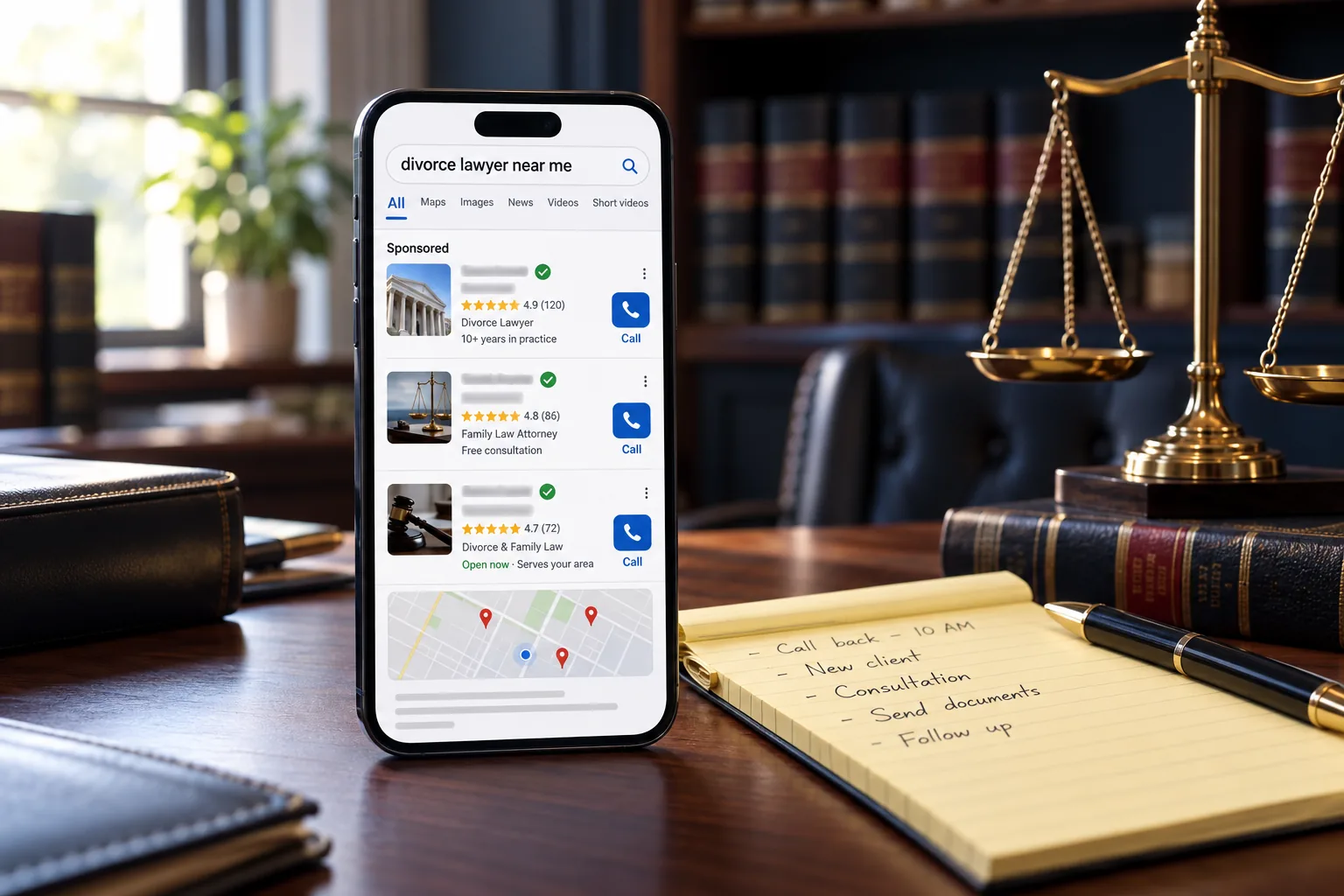
Local Services Ads are the boxes at the very top of a search like divorce lawyer near me, above the regular ads and the map. Each one shows a firm's name, rating, review count, years in business and, when the firm has passed Google's checks, a green Google Screened badge. A person can call, message or book straight from the ad.
The difference is in what you pay for and what you control. With regular Google Ads you write the ad, choose the keywords, send people to your own landing page and pay for every click, whether the person calls or not. With Local Services Ads, Google builds the ad from your profile, picks the searches it shows on from the practice areas you select, and charges you when someone actually contacts you. You give up control in exchange for paying only for contact.
- You pay for: a call, a message or a booking that Google counts as a lead. Not a click, and not an impression.
- You choose: practice areas, the area you serve, your hours, your budget and how you bid, either letting Google get as many leads as it can within the budget or setting the most you'll pay for one lead. Google handles the rest.
- You don't get: keyword control, a landing page or ad copy. The ad is your profile.
- What shows on the ad: your reviews and rating, which is why reviews count for more here than in any other paid channel.
How does Google decide which law firm shows first?
Google says plainly that the order is set by an auction that weighs your bid and the quality of your profile. Its help page for the program lists what goes into that: how likely you are to turn a search into a lead, how responsive you are to people who contact you (missed calls count against you), your rating, your number of reviews and your average response time. It also says that higher-quality profiles may rank higher and may pay a lower cost per lead.
In plain terms, the firm that answers fast and keeps earning reviews gets more leads for less money than the firm that only raises its bid. I've seen owners turn the budget up when leads slow down. Most of the time the better fix is the phone: who picks up after 5 p.m., what happens at lunch, and whether messages get a reply within the hour.
For law firms, the Google Screened badge comes after Google verifies an active law license for every lawyer shown on the profile. Google's own page says it doesn't run a separate background check on lawyers, since getting licensed already requires one. Agencies report that the most common delay is a name on the profile that doesn't match the name on the license record, so check that first.
Don't mix it up with Google Guaranteed. That badge is for home service businesses like plumbers and roofers, and it comes with a Google money-back promise to their customers. Law firms get Google Screened instead, which carries no guarantee. It tells the searcher that Google checked the lawyers' licenses, and nothing more.
How much does a Local Services Ads lead cost for a law firm?
Google doesn't publish an average, so every number you see comes from agencies that run these accounts. Their 2026 benchmarks disagree with each other, which tells you how much the price moves with the market. Personal injury leads come out at roughly $100 to $500 each, and family law at roughly $50 to $150, with big cities at the top of each range.
The cost per lead is the wrong number to stop at. What you want is the cost per signed case. Here is the math I run with an owner:
- Total spend for the month, divided by the number of leads Google charged you for, gives your cost per lead.
- Leads that turned into a consultation, divided by total leads, gives your booking rate. Count the people you could actually help, not every caller.
- Spend divided by signed cases gives your cost per case. Put that next to the average fee for that case type and you have your answer.
- Example: $2,000 spent, 16 leads at $125, 5 consultations, 2 signed. That's $1,000 per case. For a practice where a case is worth $4,000 in fees, that's a good channel. Where a case is worth $1,500, it isn't.
When are Local Services Ads not worth it for a law firm?
I'd hold off, or turn them down, in these situations:
- Nobody answers the phone reliably. Missed calls cost you a lead and push your ranking down at the same time.
- Your practice area draws many people who can't hire you, such as people looking for free help, the wrong kind of case or the other side of a dispute. You pay for each of those calls.
- You have fewer than about ten reviews. The ad shows your review count to everyone, and a firm with 4 reviews next to one with 240 rarely gets the call.
- Nobody logs where each client came from. Without that, you can't tell whether the channel is making money or quietly losing it.
- Your service area is set wider than the area you actually want to work. Every lead in that area counts, even the ones you'd never take.
Getting money back for bad leads is harder than it used to be. Google replaced the old dispute form with a system where you rate each lead and Google decides whether to credit it. Agencies that run these accounts say credits do come through, but not for every lead you'd call bad, and not quickly. Treat credits as a small refund, not a strategy. Getting the practice areas, service area and hours right does more.
What changes now that Local Services Ads are moving into Google Ads?
Google is moving Local Services Ads out of their own dashboard and into Google Ads, as a pay-per-lead Performance Max campaign. Coverage in Search Engine Land and from agencies running the change describes a first phase starting in August 2026 for some advertisers in the United States, with more groups moving later. Each account keeps its current setup until Google tells the admin it's that account's turn.
- Before your account moves, export your lead history and reports. Agencies covering the change report that the old dashboard's history doesn't carry across.
- Expect the budget to work differently. Reports describe weekly budgets turning into daily ones and new cost-per-lead targets in place of the old manual limits.
- Leads will be answered from inside Google Ads, so whoever handles calls and messages today needs access and a little training.
- You still pay for leads, not clicks, and the ads still show on Search and Maps. The profile, reviews and responsiveness still decide most of the ranking.
The practical effect is that Local Services Ads and regular search ads end up in the same account. That's good, because you can finally see both channels' cost per lead side by side. It also means a small mistake in one campaign can drain the budget of the other, so someone needs to look at the account every week.
Want to know whether your Google Ads and Local Services Ads are bringing in cases or just calls?
Get the auditShould a law firm run Local Services Ads, Google Ads or SEO?
They answer three different needs, and most firms that grow use more than one. Local Services Ads are the quickest to start and the easiest to budget for, because you pay per contact. Regular Google Ads give you control over searches, ad copy and landing pages, which matters when a practice has high-value cases and searchers who compare before they call. SEO and your Business Profile build the traffic you don't pay for each month, and they keep working when the ad budget stops.
The order I usually suggest for a new or small firm is this: get the Business Profile and reviews in shape first, since both your map ranking and your Local Services Ads ranking lean on them, then turn on Local Services Ads with a small budget in your best practice area, then build SEO underneath. I compare the two paid and organic sides in more depth in is SEO or Google Ads better for lawyers, and the review side in how to get more Google reviews for a law firm.
One more thing to set up before you spend a dollar: a simple sheet where intake writes down, for every new client, how they found you. Local Services Ads calls show in the ad account, but signed cases only show in your own records. Owners who keep that sheet can answer the question in this post's title in a month. Owners who don't are still guessing a year later.
What does Google Ads management cost with Proximity Ranker?
On its own, Google Ads management is $499 a month, and you pay your ad spend to Google directly. On my $799 a month SEO plan it costs nothing extra, along with the audit and negative review removal. The plan is month to month. A firm that commits to six months also gets a website redesign at no charge.
If you'd rather start with a check of what you're running now, the audit is $350 for one office or $550 for two, and it looks at your ads, Business Profile, reviews and website together. A new website on its own starts at $799 and review removal is $199 for each review Google takes down. Everything is listed on the pricing page.
What else do law firm owners ask?
01Do Local Services Ads help my Google Maps ranking?
Not directly. They're a separate auction from the map pack. But they lean on the same things: reviews, rating and an accurate profile. Work that improves your Business Profile tends to help both. My guide to Google Business Profile for law firms covers the map side.
02Can I choose which practice areas my ads show for?
Yes. You pick the case types from Google's list for legal services, and you can turn individual ones off. Turn off any type you don't want to pay for, because every lead in an active type is billed.
03What is a good monthly budget to test Local Services Ads?
Enough for about 15 to 20 leads in your best practice area, which you can work out from the cost per lead in your market. That's usually enough to see your booking rate within a month or two. Less than that and one good or bad week decides the test.
04Do I need a website to run Local Services Ads?
Not to run them, since people contact you from the ad. But most people check a firm before they call, and a slow or thin website loses some of the leads you've paid for. A clear page for each practice area helps every channel.
05Can someone guarantee my firm the top Local Services Ads spot?
No. Google runs the auction on your bid and your profile, and it changes with every search. Anyone who promises a fixed top spot is promising something they don't control.