Short answer: the biggest firms spend more than most people would believe, and a typical firm spends far less. Ad-tracking data reported by the U.S. Chamber's Institute for Legal Reform puts Morgan & Morgan's TV spending at nearly $240 million in 2023. Insurance Journal reported in 2024 that auto accident, slip-and-fall and personal injury ads accounted for about $1 billion in spending. Those are national TV numbers. For a small or mid-size injury firm, the useful question is different: what does one signed case cost through each channel, and how many cases can the firm handle?
I'm Ashikur Rahman, and Proximity Ranker, the agency I founded, works only with law firms. I hold an LL.B and an LL.M and have done SEO since 2017, part of it as SEO Manager at Doctor Rank. For a Queens personal injury firm I worked with, the Google Business Profile brought in 70 calls in June 2026, 25% more than in June 2025. This post covers marketing budgets only, not legal advice.
How much do the biggest injury firms spend on TV?
A lot, and the top of the market is concentrated. Morgan & Morgan's nearly $240 million on TV in 2023 is the figure most often cited. The American Tort Reform Association, using Vivvix ad-monitoring data, estimates that all legal services advertising passed $2.5 billion across 26.9 million ads in 2024. That covers every kind of legal ad, and injury firms account for a large share of it.
Those numbers are why the TV firms dominate name recall in so many cities. They're also why matching them is the wrong goal for most firms. A firm with three lawyers can't win a TV war against a firm with a nine-figure budget. It can win the searches in its own area.
Who tracks legal ad spending, and how reliable are the numbers?
Mostly ad-monitoring companies, which estimate spending by recording ads as they air and applying typical rates. The firms themselves don't publish budgets. Many of the reports that publicize the totals come from groups that oppose lawsuit advertising, such as the Institute for Legal Reform and the American Tort Reform Association, so their framing is one-sided even when the underlying data is sound.
Treat the figures as estimates of scale, not exact budgets. They're useful for one thing: showing how crowded the TV and billboard space is. They tell a smaller firm very little about what it should spend.
What does a click cost an injury firm on Google?
More than almost any other business pays. WordStream by LocaliQ's 2025 Google Ads benchmarks put the average click for attorneys and legal services at $8.58, the highest of any industry in the report, against $5.26 across all industries. The average legal lead cost $131.63, against $70.11 overall. An earlier LocaliQ breakdown by practice area put personal injury at $9.30 a click.
Those are averages across the whole country and every kind of legal search. A search like "car accident lawyer" in a big city usually costs far more than the average, and a search in a small town can cost less. The only way to know your real number is to look at your own account, or at Google's Keyword Planner estimates for your area.
How should a smaller injury firm set its ad budget?
Work backward from a signed case. Start with how many new cases the firm can actually take each month, then estimate what each one costs through a channel.
- Cost per lead: what the channel charges for one call or form, from your own data or a benchmark.
- Lead to signed case: how many leads it takes to sign one. Track this at intake; it varies a lot by firm.
- Cost per signed case: cost per lead multiplied by the number of leads it takes.
- Budget: cost per signed case multiplied by the cases you want and can handle.
As an illustration only: at the 2025 legal average of $131.63 a lead, a firm that signs one case for every five leads pays about $658 per signed case in click costs, before management fees. Whether that's good depends entirely on what the firm's cases are worth and how fast it can handle them. Run the same sum for every channel the firm uses, and the budget decides itself.
What should a new injury firm spend in its first year?
Less than it fears, if it spends in the right order. A new firm has no data, so the first months are about getting some. Set up the Business Profile and the website properly first, because they cost little to keep running and every later channel sends people to them. Then pick one paid channel, usually Google Ads aimed at the searches closest to the office, and give it a fixed monthly test budget the firm can afford to lose.
After two or three months, the firm knows its own cost per lead and how many leads it takes to sign a case. Only then does it make sense to scale up, add a second channel, or try anything as expensive as TV or radio. Firms that start with a big budget across five channels at once usually can't tell which one worked, and they pay to learn nothing.
Does TV still work when people search on their phones?
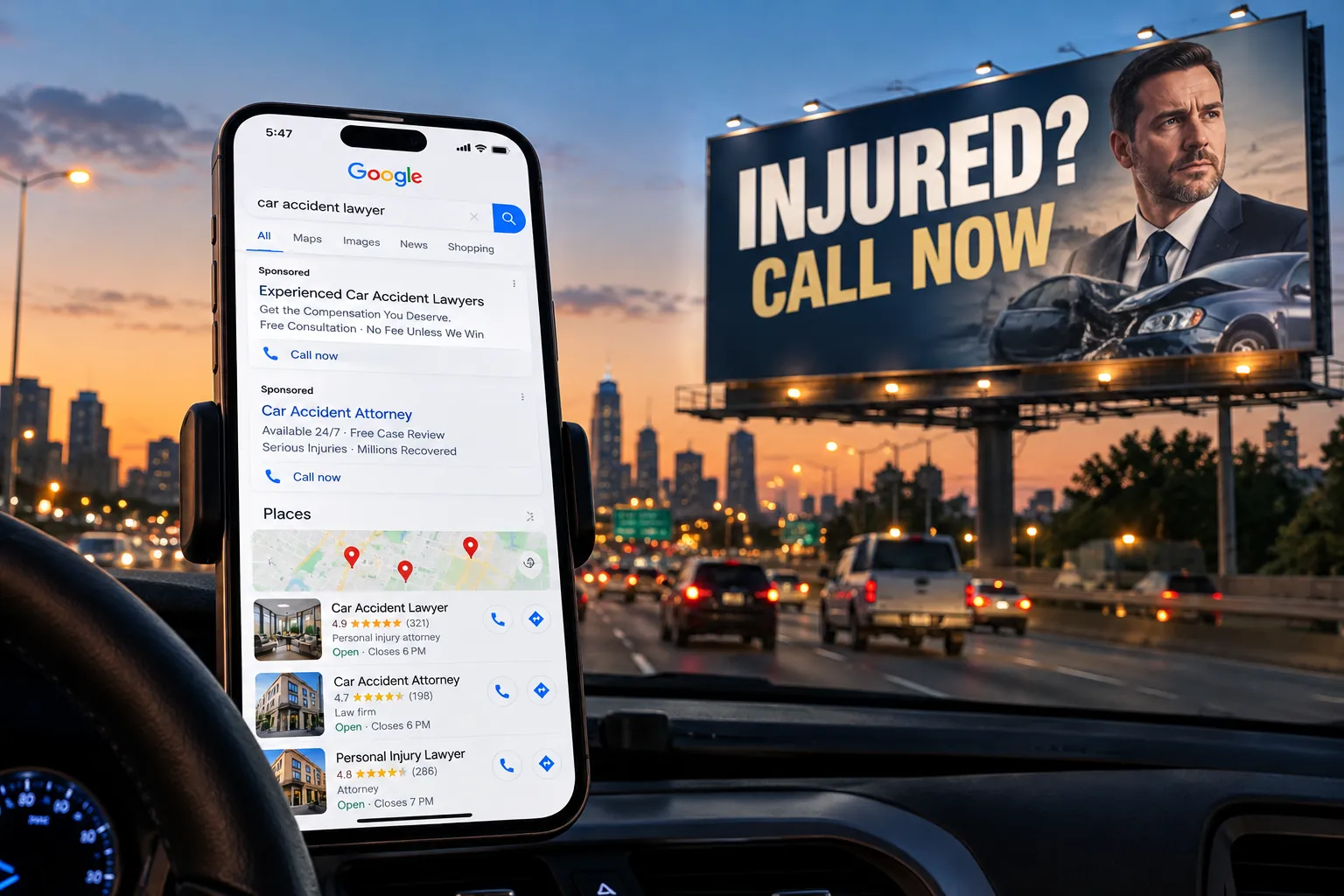
TV builds a name people remember. When someone is hurt, a lot of them search that name, or search "car accident lawyer near me" and click whichever firm they recognize. But the call still goes through Google: the ads, the map results and now the AI answers. A firm that people search for by name but that has a weak profile and few reviews is paying to send people to its competitors. My post on how injury firms get found on AI search covers what the AI tools look at.
Want to know what a signed case costs your firm in each channel?
Get the auditWhere does an injury firm's ad budget usually go besides TV?
Most firms spread money across several channels, and it's worth knowing what each one buys.
- Google Ads: you pay for each click. Fast to start and fast to stop, and expensive in competitive cities.
- Local Services Ads: you pay for each lead, shown above the regular ads with a Google screening badge. My post on whether Local Services Ads are worth it covers them.
- Lead vendors: you buy leads from a third party, often shared with other firms. Quality varies widely.
- Billboards, radio and sponsorships: build a name locally, hard to track.
- SEO: you pay for the work, not the click. Slower to start, and the results keep working after the month ends.
What is usually the cheapest way for an injury firm to get a case?
The map results and organic search, once they're built, because every call that comes from them costs nothing extra. That's why the Queens example above matters: 70 calls in one month from the profile alone. The same work also feeds the AI answers. For one injury firm I worked with, Microsoft's AI tools cited its pages 208,400 times in three months.
Organic work takes months to build, and that's the trade-off. Many firms run Google Ads while the organic side builds, then cut ad spend back as calls from the map and the website grow.
How do you know whether your ad spend is working?
Measure signed cases by source, not clicks. Use a tracking number for each channel, ask every caller how they found the firm, and record the answer at intake. Each month, divide what you spent on a channel by the cases it brought in. A channel with cheap clicks and no signed cases is expensive. A channel with costly leads that sign is a bargain. Any agency running your ads should report this number. Impressions and clicks alone don't tell you whether the money worked.
What does Google Ads management cost with me?
Google Ads management on its own is $499 a month, and firms on the SEO plan get it included. The ad budget itself is paid to Google from the firm's own account, so every dollar is visible to the firm. The SEO plan costs $799 a month for the first five firms, fixed for life while they stay, then $1,199 a month for later firms, and it can be stopped at the end of any month. The audit and negative review removal are included as well, and six months on the plan brings a new website. Full terms are on the pricing page.
What else do law firm owners ask?
01How much should a personal injury lawyer spend on Google Ads?
Start from the cost of a signed case. Multiply what a lead costs in your area by the number of leads it takes to sign one, then by the cases you want each month. Test a smaller budget first and adjust once you have your own numbers.
02Why are personal injury Google Ads so expensive?
Because a signed injury case can be worth a lot to a firm, and many firms bid on the same searches. In 2025, legal clicks averaged $8.58, the highest of any industry in WordStream by LocaliQ's benchmarks, and big-city injury searches often cost much more.
03Is TV advertising worth it for a small personal injury firm?
Rarely as a first step. TV builds a name over time, but the big firms have far larger budgets, and the results are hard to track. Most small firms get more cases per dollar from the map results, reviews and targeted Google Ads.
04Are bought personal injury leads worth it?
Sometimes. Many lead vendors sell the same lead to several firms, so speed of response decides who signs it. Track the signed-case cost from each vendor and drop the ones whose leads don't sign.
05Can SEO replace advertising for a personal injury firm?
Over time it can carry much of the load, but it takes months to build in competitive markets. Many firms keep some ad spend running while organic search and the map results grow, then reduce it as those calls increase.