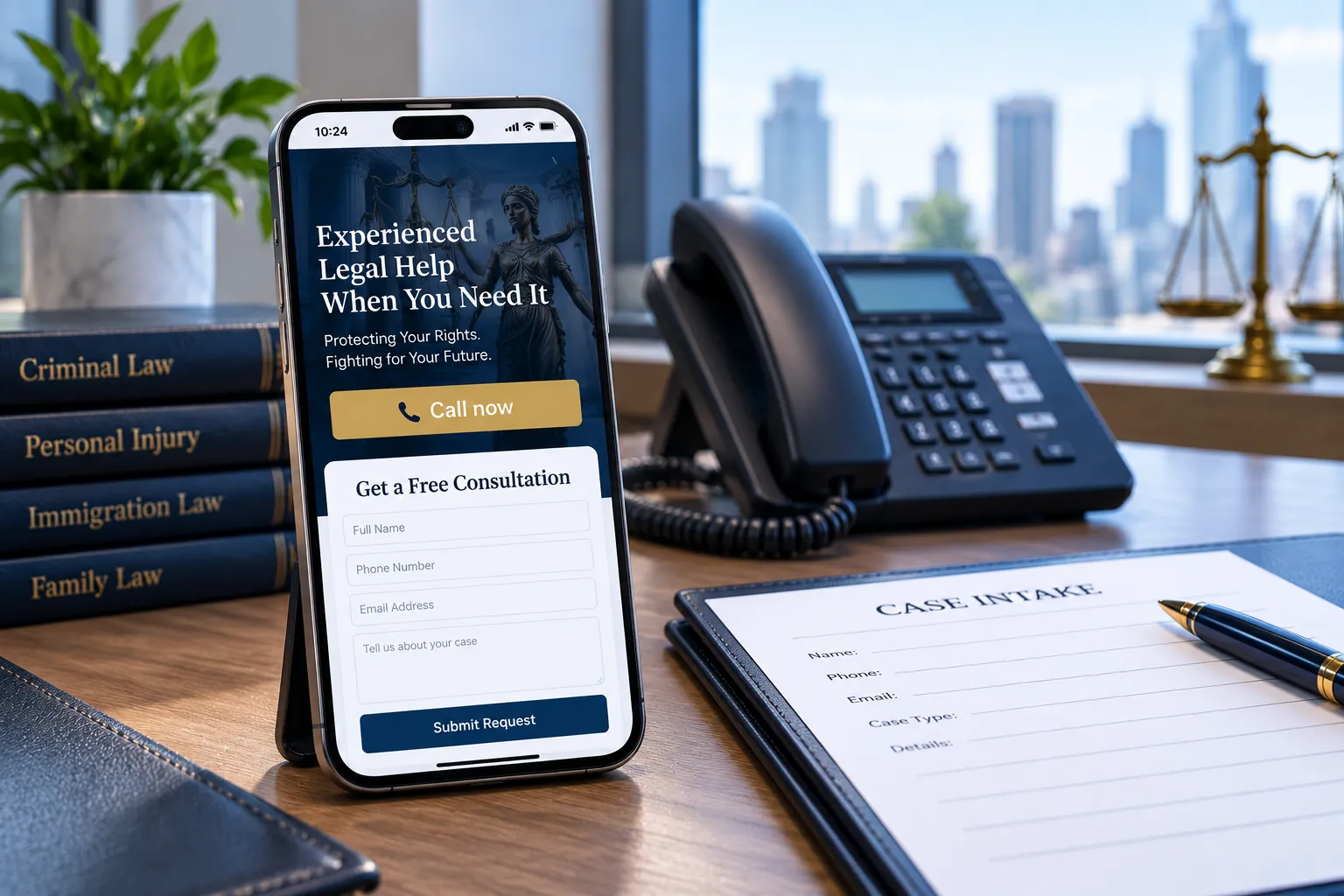

Short answer: a law firm website should be designed around the moment your client is in when they find you. Every firm needs the same base, a site that loads fast on a phone, shows a real lawyer on the first screen, gives every kind of case its own page and makes it easy to call or book. On top of that base, a divorce site, a criminal defense site, a personal injury site and an immigration site each need a different tone and a different path to the first call.
I'm Ashikur Rahman, founder of Proximity Ranker. I build websites and run SEO and AI search for law firms, and I hold an LL.B and an LL.M, so I read a firm's site the way its clients and the search engines both read it. One of the sites I worked on, a brand new New York law firm site, earned 104,000 impressions on Google in its first three months. This guide is what I've learned from that work about why some law firm websites bring in consultations and most don't.
Why isn't my law firm website bringing in new clients?
When a managing partner tells me the website gets visits but the phone doesn't ring, it's almost always one or more of these.
It's slow on a phone
Most people looking for a lawyer search on a phone, often in a hurry. Google measures page experience with Core Web Vitals, and the targets are public: the main content should appear within 2.5 seconds, the page should respond to a tap within 200 milliseconds, and the layout shouldn't jump while it loads. A theme with a video background, three sliders and a stack of tracking scripts misses all three on a mid-range phone, and people leave before the headline appears.
One page tries to cover every case type
A single practice areas page that lists eight services won't rank for any of them. Someone searching for a truck accident lawyer or a child custody lawyer wants a page about exactly that. Without one, Google sends them to a competitor who has it.
Nothing proves who the lawyer is
Martindale-Avvo's 2026 State of the Legal Consumer report found that 92.4% of people research before they hire a lawyer, and reviews were a top factor for about two in three. Stock photos of a gavel and a handshake tell that researcher nothing. Real photos, names, years in practice, reviews and results do.
The contact path is hard work
A phone number that isn't tappable, a form with twelve fields, a booking page three clicks deep. Every extra step loses people, and on a phone it loses most of them.
Search engines and AI can't read it properly
Missing titles and descriptions, no schema, pages blocked from indexing after a redesign, or a site built so the content only appears after JavaScript runs. Those sites can look fine to you and still be close to invisible on Google and in ChatGPT. I cover the AI side further down.
What does every law firm website need to turn visitors into consultations?
- A first screen that says what you do, where, and for whom, with a real lawyer's photo and a tappable phone number.
- A page for every case type you want more of, each written for the person with that problem: what happens next, what it usually costs, how long it takes and what to bring to the first meeting.
- Proof on every page: review stars and quotes, years in practice, case results you can document, and the memberships and awards you actually hold.
- Answers to the questions that decide the call: fees, how the first consultation works, whether you take their kind of case, which languages you speak.
- A page for each office, with the address, a map, hours and parking, so Google and the AI engines can tie the firm to each city it serves.
- Two ways to reach you everywhere: click to call, and a short form or a booking link. Both tracked, so you know which pages bring in cases.
- Clean technical setup: HTTPS on every page, fast hosting, an XML sitemap, schema for the firm and each lawyer, proper redirects from any old URLs, and nothing important hidden behind JavaScript.
Want to know exactly why your current site isn't bringing in consultations?
Get the auditHow should the design change for divorce, criminal defense, personal injury and immigration firms?
The base stays the same. What changes is how the client feels when they land on your site, and the design has to meet that.
Divorce and family law websites
These visitors are often frightened, and many are researching in private, sometimes on a shared phone or computer. The site should feel calm and warm, never aggressive. Add a quick-exit button that jumps to a neutral page, keep the contact form to a name and a safe way to reach them, and never send an auto-reply that announces what the email is about. Separate pages for divorce, custody, support and the other matters you handle let people find their exact situation without reading about everyone else's.
Criminal defense and DUI websites
These searches happen at night and on weekends, right after an arrest, and the person searching is often a parent or a partner rather than the client. The phone number has to be the biggest thing on the screen, with the hours it's answered stated plainly. A page per charge, a page on what happens after an arrest, and results described in words people understand (dismissed, reduced, not guilty) do most of the work. Keep it discreet: no pop-ups, and a short form.
Personal injury websites
Injury clients are hurt, worried about money and often searching from a hospital or the roadside. They want three answers fast: do I have a case, what will it cost me, and can I talk to someone now. A free case review form you can finish with one thumb, click to call in the header, a page per accident type and an honest explanation of how your fee works carry most of the weight. It's also the most crowded practice in legal search, so speed and conversion matter more here than anywhere.
Immigration websites
Many immigration clients read in a second language and have been let down by someone before. Full pages in each language your clients speak (not a translate widget), a language switch at the top of every page, a page for each kind of case and a clear statement of who the lawyers are build the trust that gets the call.
WordPress or a custom-coded website: which is better for a law firm?
This is one of the questions I'm asked most, and the honest answer is that both can work. It depends on who will look after the site.
What WordPress does well
- It runs about four in ten websites on the internet, so developers, themes and plugins are easy to find.
- Staff can edit pages and publish posts from a dashboard without a developer.
- A cheap template can be live in days.
Where WordPress costs law firms
- Security. Patchstack logged 11,334 new vulnerabilities in the WordPress ecosystem in 2025, and 91% of them were in plugins. Every plugin on a firm's site is one more thing that has to be kept updated.
- Speed. Page builders and stacked plugins add weight, which is why so many WordPress law firm sites fail Core Web Vitals on a phone.
- Upkeep. Updates, backups, security scans and plugin conflicts are ongoing work. When nobody does them, the site slowly breaks.
What a custom-coded site does well
- No plugins to patch and no admin login page on your domain for bots to hammer.
- Fast by default, because only the code the page needs is shipped.
- Pages can be sent to browsers and crawlers as finished HTML, which matters for AI search.
- Cheap and simple to host.
The trade-off is editing: on a custom-coded site, bigger changes go through the developer. For most firms that's fine, because the site changes a few times a year and the blog is handled with the SEO work. If your firm has someone in-house who publishes every day and wants full control, a well-maintained WordPress site can be the better choice. I build custom React sites, server-rendered so every page arrives complete, because for a firm that wants speed, security and AI visibility without a maintenance burden, that's what works.
How does a law firm website get cited by ChatGPT and Google's AI?
A growing share of clients ask ChatGPT, Gemini, Perplexity, Google's AI Overviews or AI Mode which lawyer to call before they search the usual way. For your site to be part of those answers, three things have to be true.
The AI crawlers can read your pages
Research by Vercel and MERJ found that the major AI crawlers, including OpenAI's GPTBot, OAI-SearchBot and ChatGPT-User and Anthropic's ClaudeBot, download JavaScript files but don't run them. If your site only shows its content after JavaScript runs, those crawlers see an empty page. Googlebot and Gemini do render JavaScript, which is why a site can rank on Google and still be invisible to ChatGPT. Check your robots.txt and your firewall too: Cloudflare began blocking known AI crawlers by default on new sites in July 2025, and plenty of firms have no idea it's switched on.
The pages answer questions directly
AI answers quote pages that answer the question in the first sentence or two, then explain. A case type page that opens with the answer, uses the words clients use and has a short FAQ is far more likely to be cited than one that opens with three paragraphs about the firm's values.
The engines can confirm who you are
Schema markup for the firm and every lawyer, and the same name, address, phone and practice description on your site, your Google Business Profile, the bar directory, Avvo, Justia and anywhere else you're listed. I go deeper in how law firms get recommended by ChatGPT.
How do you know if your law firm website is working?
Traffic on its own doesn't tell you much. These four numbers do, and every site I build reports them:
- Calls from the site and from your Google Business Profile, tracked by source.
- Form submissions and bookings, by page, so you know which case type pages bring in work.
- Clicks and impressions in Google Search Console for the searches you want to win.
- AI citations and AI impressions from Bing Webmaster Tools and Google Search Console, so you can see whether the AI engines are using your pages.
How much does a law firm website cost, and what do you get with mine?
Law firm websites are priced anywhere from a few hundred dollars for a template to tens of thousands for a large agency build. The price should buy the structure (a page for every case type), the writing, the speed and the search setup, not just the look.
My prices are published on the pricing page. A custom law firm website is $799 on its own for up to 10 pages, $1,599 up to 25 and $2,599 up to 50: design, development, the content, and full setup for Google and AI search, with half paid before work starts and half at launch. It's free if you take my SEO plan for six months. Bought on its own, it's built on your hosting and the code is yours from day one. Free with the SEO plan, it's built on my account and connected to your domain, and after six months I hand over every file.
The SEO plan is $799 a month, month to month, and covers local and on-page SEO, Google Business Profile optimization, AI search optimization and a monthly report from the real dashboards. The audit, negative review removal and Google Ads management are included free on the plan. On their own, the audit is $350 for one office or $550 for two, review removal is $199 for each review Google actually removes, and Google Ads management is $499 a month. More on how I build in law firm website design.
What should you ask before you hire a law firm web designer?
- Will every case type get its own page, and who writes them?
- How fast will the site load on a phone, and will you show me the Core Web Vitals?
- Will the pages arrive as finished HTML, so ChatGPT and Claude can read them?
- Who owns the domain, the hosting and the files?
- What happens to my current rankings at launch? The answer should mention redirects.
- How will I know which pages bring in calls and consultations?
What else do law firm owners ask?
01How long does it take to build a law firm website?
Usually a few weeks, not months. Most of the time goes into content: the practice area pages, the lawyer bios and real photos. Once I have your photos and your approval on the page structure, the build moves quickly, and I check Search Console before and after launch so any dip is caught in days. A website starts at $799, or free with six months of the SEO plan.
02Does a law firm website need to be accessible to people with disabilities?
Build it that way from the start. An accessible site has readable contrast, text that resizes, buttons big enough to tap, alt text on images and forms that work with a keyboard and a screen reader. The benchmark most designers build to is WCAG 2.2 level AA. It helps everyone else too, from older clients to someone reading on a cracked phone in a hospital waiting room. Every site I build has accessible contrast, text sizes and controls.
03Can I redesign my website without losing my Google rankings?
Yes, if the old URLs are handled. Before launch, list every page Google already shows, map each one to its closest new page and set a permanent 301 redirect that lands in one hop, never on the homepage. Keep the titles and content that already rank, resubmit the sitemap and watch Search Console for the first few weeks. A small dip in the first week or two is normal. One that keeps falling after a month means something was missed. I did this on my own site in October 2026, moving more than 80 old URLs onto their new pages.
04What should an attorney bio page include?
A real photo, the lawyer's full name, the practice areas they handle, bar admissions, education, years in practice, languages spoken and the memberships and awards they actually hold. Then something human: why they do this work and what a first meeting with them is like, with a way to book that lawyer at the bottom. The bio is often the second page a client reads, and it's where AI engines confirm who a lawyer is, so each lawyer gets a separate page with Person schema.
05How do I track which calls and forms came from my website?
Set up Google Analytics 4 with conversion events for form submissions and taps on your phone number, and use call tracking numbers that change by source, so calls from Google Ads, your Business Profile and the website show up separately. Add UTM tags to the website link on your Google Business Profile so profile visits don't blend into ordinary search traffic. Then ask every new client how they found you. The monthly report on my SEO plan reads these numbers from the real dashboards.