Short answer: law firms show up in Google AI Overviews by having pages that Google has indexed, trusts and can quote, pages that answer the exact question a client typed in their first lines, from a firm whose lawyers, details and reviews Google can confirm. Google says there are no special technical requirements beyond being indexed and eligible for a snippet. There's nothing to submit and nothing to buy. The work is making your page the clearest, most trustworthy answer to the question.
I'm Ashikur Rahman, founder of Proximity Ranker. I do SEO and AI search for law firms, backed by legal training (an LL.B and an LL.M). One personal injury firm I work with earned 3.55 million impressions and 23,300 clicks from Google in six months, and the same pages that rank in its regular results are the ones Google pulls into its AI answers. This guide covers how that selection works and what you can control. It's written for firm owners about search, and none of it is legal advice.
What are Google AI Overviews, and how often do they show for legal searches?
An AI Overview is the summary Google writes at the top of some results pages, with links to the pages it drew from. Google launched AI Overviews in the United States on May 14, 2024, after testing them for a year as the Search Generative Experience, and said in July 2025 that more than 2 billion people a month used them. AI Mode is a separate, conversational tab that answers longer questions and follow-ups in the same way.
How often they appear on legal searches depends on who's counting. Ahrefs data, as reported in industry coverage, put AI Overviews on about 23.6% of legal queries overall but 57.9% of question-style legal queries, and other studies report figures above 75%. The studies disagree on the totals, but they agree on the pattern: questions trigger AI Overviews far more than short searches. A full question about choosing a divorce lawyer for a custody dispute is far more likely to get one than the two words divorce lawyer.
That matters because questions are where a lot of legal clients start. They ask what a case involves, what it costs and how to choose someone before they search for a firm by name. Pew Research Center found that when an AI summary appeared, people clicked a regular result on only 8% of visits, against 15% without one. If your firm isn't in the summary, many of those people never get as far as your link.
How does Google choose which law firm pages to cite in an AI Overview?
Google's own documentation gives the outline. AI Overviews and AI Mode are rooted in the same ranking and quality systems as regular Search. To be eligible as a supporting link, a page has to be indexed and eligible to show with a snippet, with no additional technical requirements. And both features use what Google calls query fan-out: they run several related searches across subtopics and cite supporting pages from all of them.
Fan-out is the part most firms miss. Ask how much does a personal injury lawyer cost, and Google may also search for contingency fees, what the percentage usually covers, whether you pay if you lose and how to compare quotes. A firm with a clear page on any of those can be cited, even if it isn't in the top results for the original question. That's what the 2026 Ahrefs study of 863,000 keywords found: only 38% of AI Overview citations came from pages ranking in the top 10, down from 76% in its July 2025 study. Ahrefs changed its method between the two, so the size of the drop is uncertain, but the direction is clear.
Trust weighs more heavily on legal searches. Google's quality rater guidelines group legal topics with health and money as subjects where a bad answer can hurt someone, and say trust matters most there. In practice Google leans toward pages that show who wrote them, why that person is qualified and how the firm can be verified.
What kind of law firm page gets cited in AI Overviews?
The law firm pages that get cited tend to share a shape:
- One topic per page. A page about truck accident claims beats a personal injury page that mentions trucks in a list.
- The answer first. The opening two or three sentences answer the question directly, before any story about the firm.
- Headings that are the questions clients ask, so Google can match a section to a fan-out search.
- Specifics: how fees work at this firm, what the first meeting covers, how long a typical case of this kind takes here, the lawyer who handles it. The research behind generative engine optimization found that citations, quotations and statistics raised a source's visibility in AI answers by up to 40%.
- A named lawyer as author or reviewer, with a bio that lists admissions, years in practice and case types, and a visible last-reviewed date.
- Tables for comparisons such as fee structures or options, which give Google clean facts to pull.
Here's the difference in practice. A typical car accident page opens: our experienced team fights for the compensation you deserve. There's nothing in that sentence for Google to quote. A page that gets cited opens with how the firm charges, in plain words: no fee unless the case is won, the percentage stated, and what the client pays if it isn't. That second version answers a real question, so it can be used.
Does a law firm need to rank on page one to appear in AI Overviews?
No, but it needs to be in Google's index and close to the topic. Because of fan-out, a page ranking 15th for the original question can be the best match for one of the sub-questions and get cited. What it can't be is unindexed. A page sitting at Discovered, currently not indexed or Crawled, currently not indexed in Search Console is invisible to AI Overviews however good it is.
So the first check I run for any firm is the URL Inspection tool in Search Console on every money page. It's common to find a firm's best practice pages unindexed after a redesign or a URL change, while old pages nobody updates keep collecting the impressions.
What keeps a law firm out of AI Overviews?
- Pages that aren't indexed, or that canonical to another URL, often after a site migration that never got a clean redirect map.
- A nosnippet tag, data-nosnippet sections or max-snippet set to zero, sometimes switched on by a theme or SEO plugin. Google says these keep content out of AI Overviews and AI Mode, and they remove your regular snippet as well.
- Thin practice pages: one generic page covering every case type, or city pages that only swap the town name.
- Firm details that disagree between the website, the Business Profile and the legal directories, which gives Google a reason to prefer another source.
- No visible author, credentials or dates on pages about legal problems, where Google asks for the most trust.
- Answers buried under long introductions, so no passage on the page works as a quote.
One thing that doesn't keep you out: blocking Google-Extended in robots.txt. That setting controls whether Google uses your content for its Gemini models; it doesn't affect Search, so it doesn't affect AI Overviews either.
How does a law firm's Google Business Profile fit with AI Overviews?
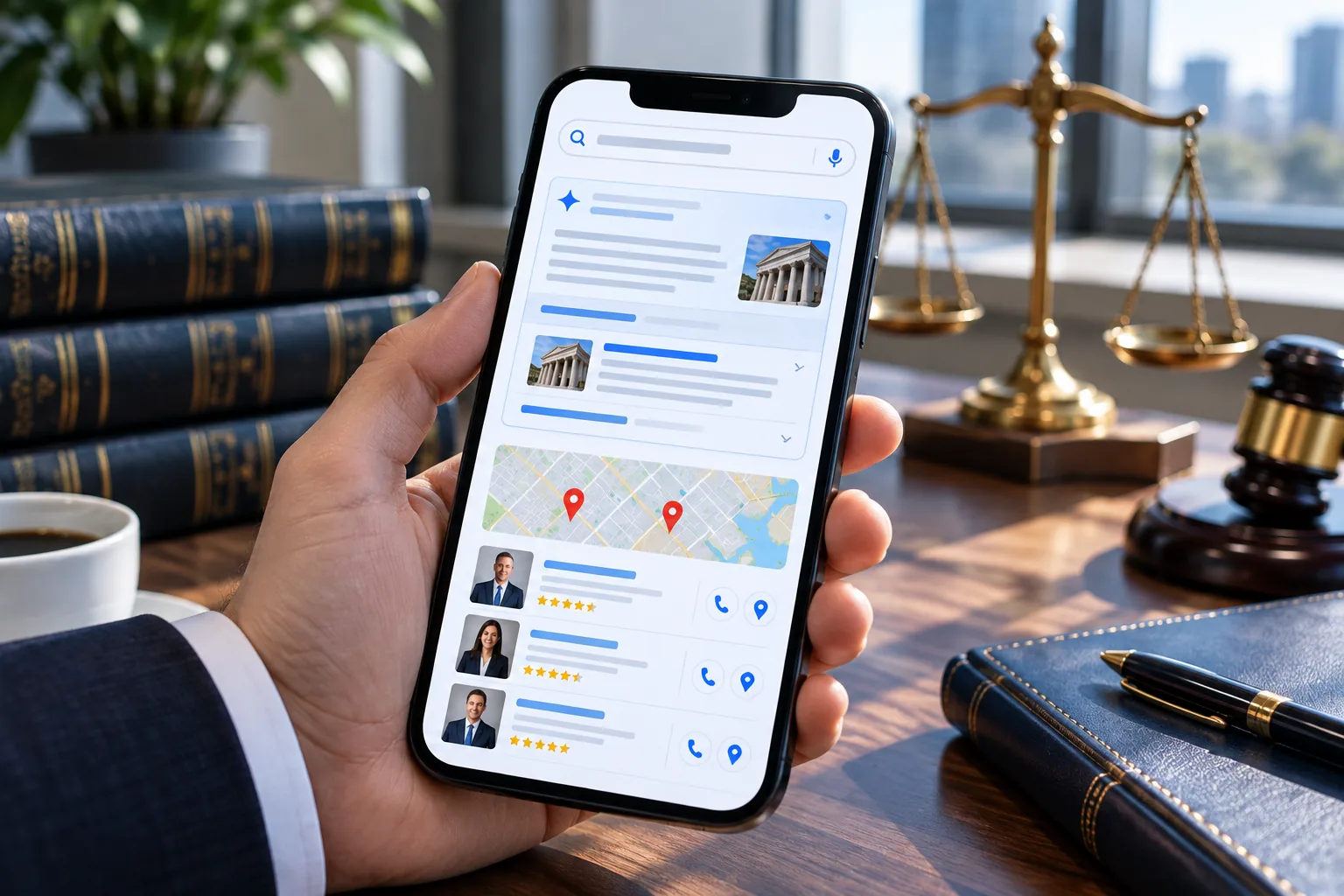
For local legal searches, the AI Overview, the map pack and the regular results often share the same screen, and the client looks at all of them. Your Business Profile does the work in the map pack: the right primary category, services that match your case types, accurate hours, a link to the right page, photos of the real office and reviews that describe the help. Google ranks those local results on relevance, distance and prominence, and prominence includes your reviews and how widely the firm is known.
The profile and the website also back each other up. When the same firm name, lawyers, address and practice areas appear on both, and on your bar or law society listing and the directories, Google has fewer reasons to doubt which firm a page belongs to. For one Queens injury firm I work with, that combined work took the profile to 70 calls in June 2026, 25% more than in June 2025. My Google Business Profile guide for law firms covers the profile in detail.
How can a law firm track its AI Overview visibility?
- Search Console's Performance report: impressions and clicks from AI Overviews and AI Mode count in your totals, so question queries whose impressions climb while clicks hold flat are often being answered on the results page.
- Search Console's generative AI report: launched in June 2026, it shows the impressions your pages earned in AI Overviews and AI Mode, by page, country, device and date. It has no queries and no clicks, so read it as a trend line for each page.
- A monthly manual check: search your 20 to 30 most valuable questions in a private window from your office location, note whether an AI Overview appears and which firms and pages it links. Location changes the answer, so always check from the same place.
- Rank tracking software that flags AI Overviews, for a wider sample than you can check by hand.
- Intake: ask every new client what they searched and what they saw, and log it. The phone is where AI visibility either turns into cases or doesn't.
Can a law firm opt out of AI Overviews, and should it?
You can, but it's rarely a good trade. The page-level controls that remove content from AI Overviews (nosnippet, data-nosnippet and max-snippet) also strip or shorten your regular snippet, which usually costs you clicks from ordinary results too. Blocking Googlebot removes you from Search entirely. For a firm that needs new clients from search, being the source Google quotes is worth more than the clicks an opt-out might protect.
Want to see which of your pages Google is using in AI Overviews?
Get the auditWhat does AI Overview optimization cost for a law firm?
It's part of the monthly SEO plan, not an add-on. The plan is $799 a month, month to month, and it covers local and on-page SEO, Google Business Profile optimization, AI search optimization for AI Overviews, AI Mode, ChatGPT and the other engines, and a monthly report built from your Search Console, Business Profile and Bing data. Firms on the plan get the audit, negative review removal and Google Ads management free, and a six-month commitment brings a free website.
Separately, the audit costs $350 for one office or $550 for two and shows which of your pages are indexed, which questions trigger AI Overviews in your market and who Google cites instead of you. A website on its own starts at $799, review removal is $199 for each review removed and Ads management is $499 a month. Everything is listed on the pricing page. For the bigger picture, see AI search optimization for lawyers and what an AEO strategy for a law firm includes.
What else do law firm owners ask?
01Is Google AI Mode the same as AI Overviews?
They're related but not the same. AI Overviews appear at the top of a normal results page; AI Mode is a separate tab for longer, conversational searches with follow-up questions. Google says both use query fan-out but can use different models and techniques, so they can cite different pages for the same question. A page that answers clearly tends to do well in both.
02Do Google Ads appear in AI Overviews?
Google can show labeled ads above, below and within AI Overviews in some markets. Those ad slots are bought, but the summary itself and the pages it cites are not. A firm can run ads and still be missing from the summary, or be cited without spending anything on ads.
03Does schema markup get a law firm into AI Overviews?
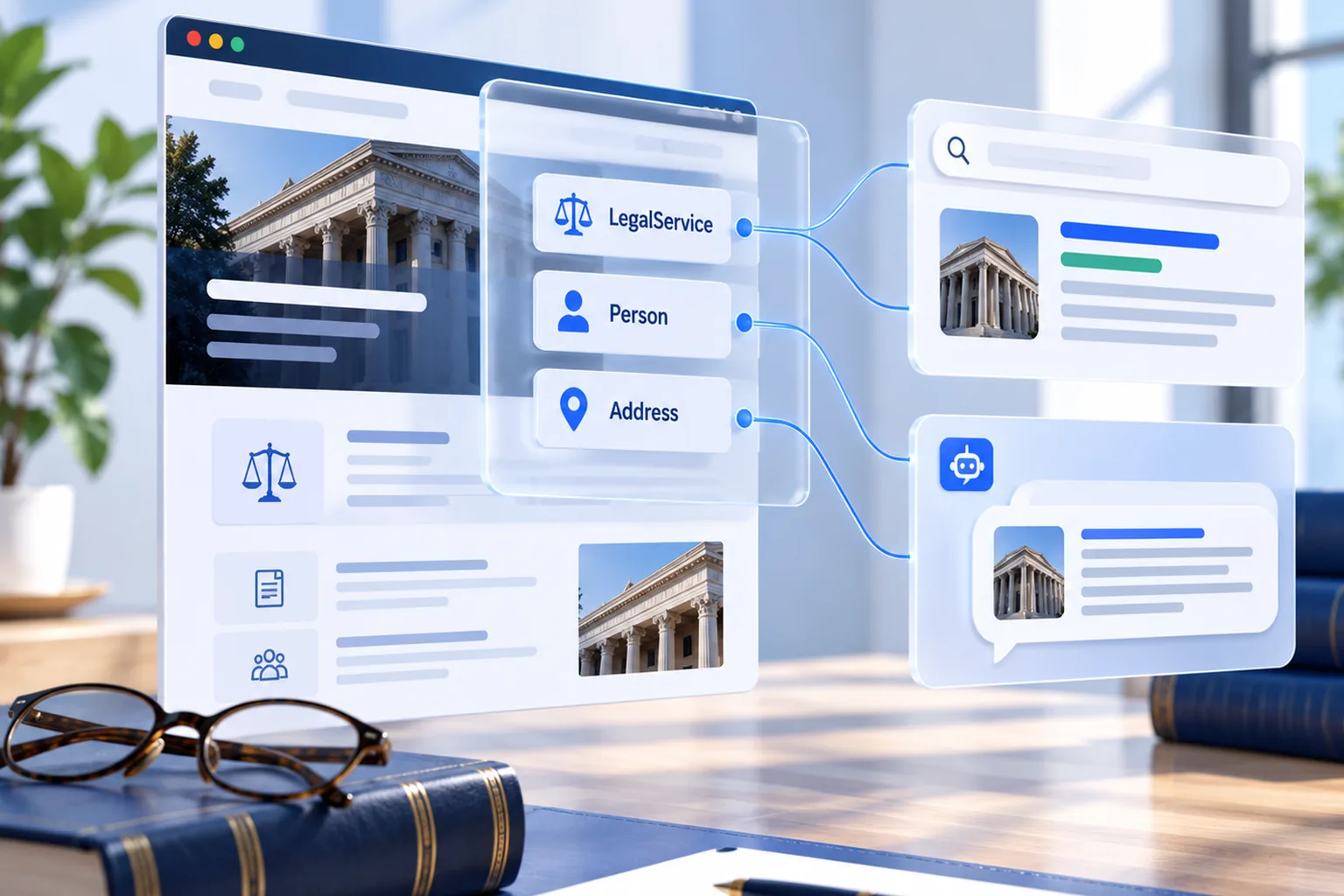
Not on its own. Google says no special markup is needed for AI features. LegalService and Person markup help Google understand who the firm and its lawyers are, which supports trust, but a page still gets cited for its answer, not its code. Keep the markup accurate and matching what's on the page.
04Why does the AI Overview for the same question change from day to day?
The answer is generated fresh, and it varies with the exact wording, the searcher's location, the device and changes in Google's index. That's why a single screenshot proves little. Track a fixed set of questions from a fixed location every month and look at how often your firm appears over time.
05Do AI Overviews mean fewer calls for law firms?
They mean fewer clicks on ordinary results for informational questions, which Pew's research shows. Calls depend on whether your firm is the one named and cited when the client is ready to choose. Firms that show up in the summary, the map pack and the results together tend to keep their calls. Firms that relied on ranking alone feel the drop first.