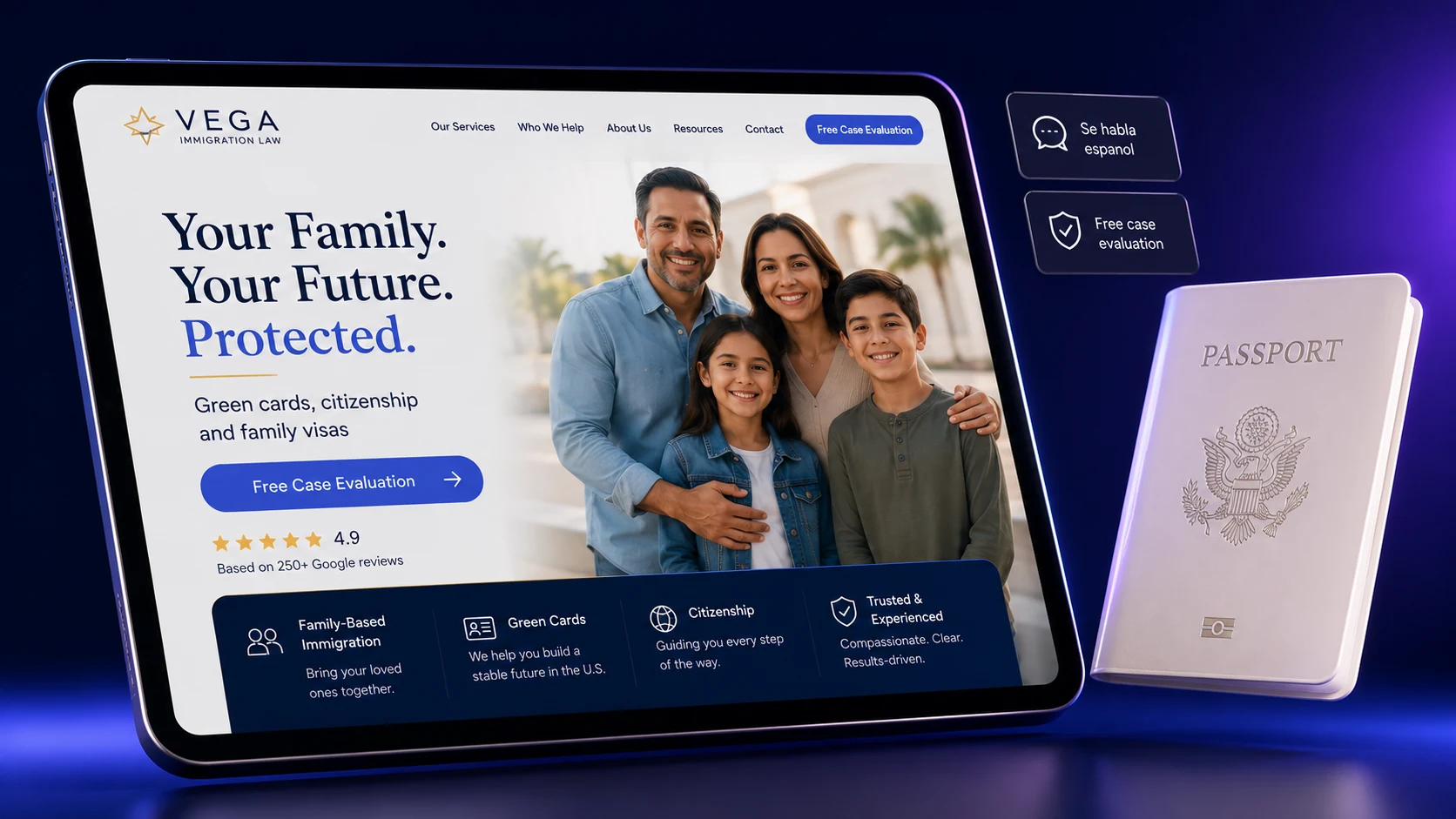
Most immigration firms already know their clients do not all think in English. Many have Spanish-speaking staff, take calls in Mandarin or Tagalog, and hand out translated intake forms. Then the website is English-only, or it has a little flag icon that runs the page through a translation widget. The result is that the firm is invisible to everyone who searches in their own language.
This is the single largest missed opportunity I see on immigration sites, so it gets its own post.
How big the opportunity is
According to the Census Bureau's American Community Survey for 2018 to 2022, 78.3% of people in the United States aged five and over speak only English at home. That leaves roughly one in five who speak another language. Among them, Spanish accounts for 61.1%, Chinese for 5.1% and Tagalog for 2.5%. For an immigration practice, the share of clients who prefer another language is obviously much higher than the national figure.
Many people who are comfortable speaking English still search in their first language when the topic is frightening and personal. A question about a detained relative or a visa that is about to expire is exactly that kind of topic.
What Google actually needs
Google's guidance on multilingual sites is clear, and most translation plugins ignore it. The main points:
- Give each language version its own URL, for example /es/green-card-matrimonio rather than the same address with the language switched by a cookie or a script.
- Connect the versions with hreflang annotations, so Google can show the Spanish page to a Spanish searcher and the English page to an English one.
- Use one language per page. Google decides a page's language from its visible content, and side-by-side translations confuse it.
- Do not automatically redirect visitors based on their browser language. Google's crawler usually requests pages without a language preference, so it may never see your other versions.
A translation widget that rewrites the page in the visitor's browser fails most of these. Google indexes the English page, and the Spanish version never exists as something that can rank. It also tends to produce stiff, sometimes wrong legal language, which is the last thing a careful reader wants to see.
Which pages to translate first
You do not need to translate the whole site on day one. Start with the pages that turn a search into a consultation:
- Your two or three most important case types, the ones that bring in most of your work.
- The attorney pages, including which attorneys and staff speak the language.
- The contact or consultation page, with a phone number that is answered by someone who speaks the language.
- A plain explanation of who can and cannot help with an immigration case, written for people who may have been approached by a notario.
Once those are live and reviewed, build out the remaining case types and the most-asked questions. Watching which translated pages get impressions in Search Console tells you where to go next.
Want to know which of your pages would bring in the most Spanish-speaking clients?
Get your free auditAccuracy is not optional
Legal terms do not translate word for word. Notario is the classic example: in much of Latin America a notario público is a trained legal professional, while in the United States a notary public is not a lawyer and cannot give legal advice. A page that uses the word carelessly can mislead the exact reader you are trying to protect.
Every translated page should be reviewed by a bilingual person who understands the subject, ideally an attorney or experienced staff member at your firm, before it publishes. A machine draft is a reasonable starting point. A machine draft published as-is is a risk, both to your reputation and under the attorney advertising rules that apply to your firm.
Do not promise language help you cannot deliver
If the website says se habla español, someone who speaks Spanish has to answer the phone, reply to the form and sit in the consultation. A Spanish page that leads to an English-only intake process loses the client at the worst possible moment and earns the kind of review nobody wants. Only build pages for languages your firm can actually serve.
The same applies to AI answers
When someone asks ChatGPT or Google's AI Overviews an immigration question in Spanish, the answer is built mostly from Spanish sources. A firm with strong English pages and nothing in Spanish is simply not a candidate for that answer. Real, indexable pages in your clients' languages help you in the map pack, in the blue links and in AI answers.
Multilingual pages are part of how I approach SEO for immigration lawyers and how I design immigration firm websites: planned in from the start rather than bolted on later.

Founder of Proximity Ranker, with nine years in SEO and an LL.M in International Law. Not a licensed attorney, and nothing here is legal advice. Meet the founder.